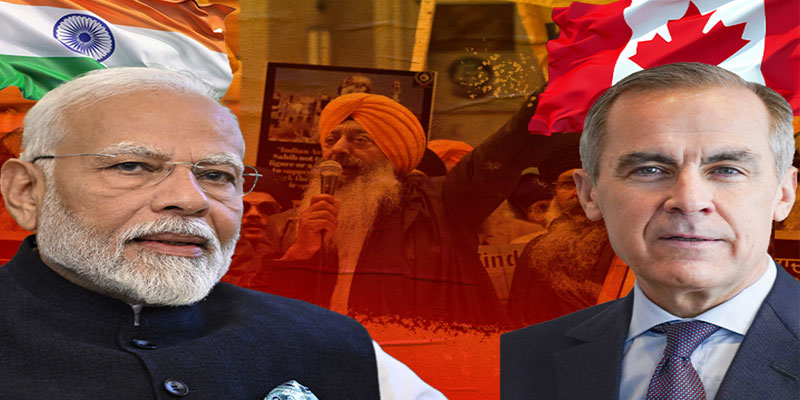
Beyond the trade deal, India and Canada are looking to build a wider economic partnership, transforming renewed diplomatic engagement into lasting cooperation across trade, technology, energy and security. Prime Minister Narendra Modi’s October 13 conversation with Canadian Prime Minister Mark Carney signals a determined effort to turn improving relations into tangible economic and strategic outcomes.
From Diplomatic Strain to Renewed Engagement
India–Canada relations deteriorated sharply in 2023 following allegations linked to the killing of Hardeep Singh Nijjar in British Columbia. The dispute triggered reciprocal diplomatic expulsions and stalled progress on trade negotiations, creating uncertainty around the broader bilateral partnership.
Relations began recovering after Carney became Canada’s prime minister in 2025. Meetings between Modi and Carney at the G7 Summit in Kananaskis in June and the G20 Summit in Johannesburg in November helped restore political engagement and establish the foundation for a high-ambition Comprehensive Economic Partnership Agreement (CEPA).
In March 2026, the two countries signed the formal Terms of Reference for negotiations during Carney’s visit to New Delhi, setting the framework for discussions covering goods, services and other mutually agreed areas.
Leaders Reinforce Trade Ambitions
During their latest conversation, both leaders reaffirmed their commitment to concluding CEPA at the earliest opportunity, supporting their shared ambition to substantially expand bilateral commerce by 2030.
The leaders also welcomed growing engagement over the past year across finance, defence and security, artificial intelligence and people-to-people exchanges.
Canada’s ongoing Team Canada trade mission to India, led by International Trade Minister Maninder Sidhu, alongside Foreign Minister Anita Anand’s visit to New Delhi, underscores Ottawa’s efforts to strengthen commercial links and diversify exports beyond the United States.
CEPA: The Economic Partnership’s Cornerstone
The proposed agreement aims to reduce trade barriers, improve market access and facilitate investment, professional mobility and supply-chain integration. Four negotiation rounds had been completed by September 2026, with both governments targeting a conclusion by year-end.
Key opportunities include:
· For India: Greater access to Canadian markets, critical minerals, clean energy, agricultural technology and financial services.
· For Canada: Access to India’s expanding consumer market, investment opportunities and a stronger economic partnership beyond its traditional dependence on the US market.
Security and Indo-Pacific Cooperation Expand
Beyond commerce, Modi and Carney discussed Indo-Pacific instability, energy security and agricultural cooperation. They also welcomed a recent bilateral security dialogue in India, reflecting efforts to strengthen institutional cooperation on security and law enforcement.
Converting Political Will into Lasting Results
The immediate challenge is resolving outstanding differences over tariffs, services, investment protections and professional mobility. Modi’s planned December visit to Canada could provide fresh momentum toward completing negotiations.
Ultimately, the success of this diplomatic reset will depend on whether both governments translate goodwill into measurable outcomes. A timely CEPA could become more than a trade agreement: it could anchor a resilient partnership built on economic diversification, strategic trust and shared Indo-Pacific interests.
(With agency inputs)