
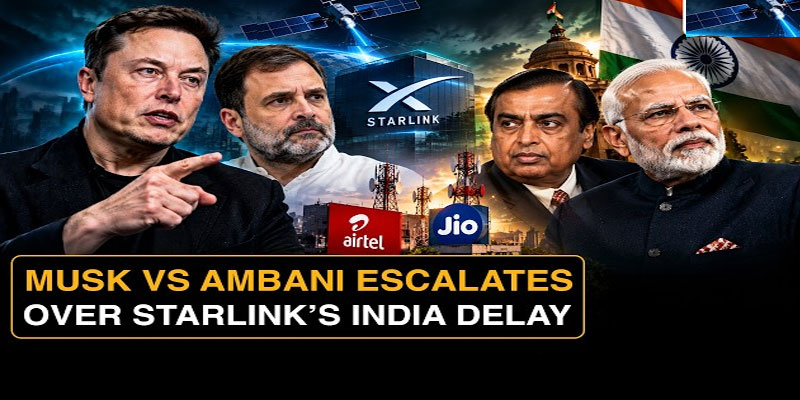
Elon Musk’s public challenge to Mukesh Ambani has brought India’s emerging satellite broadband market into the spotlight, transforming a delayed commercial launch into a wider debate over competition, regulation and market access. With Starlink seeking entry and Reliance Jio preparing its own satellite ambitions, the contest could reshape connectivity in remote regions and high-value industries. However, the government maintains that the competing operators are awaiting the necessary clearances, with no company officially selected for preferential treatment.
A Race to Connect India from Space
Satellite broadband can deliver internet connectivity to locations where conventional mobile networks and fibre-optic infrastructure are difficult or expensive to deploy. India’s vast geography, remote villages, islands, border regions and maritime routes offer significant opportunities for such services.
Musk’s Allegation: Is Ambani Blocking Competition?
Musk took his frustration to X, claiming that Starlink had spent five years complying with Indian laws without obtaining all the approvals required to launch commercially. He provocatively asked, “Is Ambani the real boss of India?” while alleging that unnamed Indian business interests were obstructing competition.
India’s Ministry of Communications rejected the accusation as “baseless and misconceived,” asserting that the regulatory framework was fair and non-discriminatory.
The government’s position is that Starlink, OneWeb and Jio Satellite Communications remain subject to security clearances and spectrum assignment. Although Starlink has obtained its GMPCS licence and IN-SPACe authorisation, additional approvals remain necessary.
Crucially, no established evidence demonstrates that Ambani or Jio caused Starlink’s delay. The immediate regulatory hurdles, rather than proven corporate interference, remain central to the dispute.
Why Musk Wants an Early Entry
Starlink’s urgency reflects several commercial considerations:
· First-mover advantage: Early entry could help establish customer loyalty, distribution networks and installation support.
· High-value customers: Government agencies, defence-related operations, shipping, aviation, mining and remote businesses could provide substantial demand.
· Competitive pressure: Jio’s extensive distribution network and existing telecom ecosystem could make customer acquisition easier once its satellite services become operational.
Jio’s Countermove: Building Sovereign Connectivity
At India Mobile Congress 2026, Jio presented a proposal for a “Sovereign Satellite Connectivity” network comprising approximately 1,600 low-Earth-orbit satellites and 23 ground stations.
The proposed system would serve remote villages, islands, border areas and maritime locations while complementing Jio’s terrestrial network. However, it remains a proposal, requiring substantial investment, technical execution and regulatory approvals.
Zoho founder Sridhar Vembu defended India’s competitive environment, citing affordable mobile data and digital services as evidence that domestic competition can benefit consumers. Rahul Gandhi, meanwhile, mocked Musk’s complaint, writing: “Welcome to India, Elon. Wait till you discover the other guy.”
Regulation Will Decide the Race
Starlink brings operational experience and an established satellite constellation; Jio offers domestic scale, distribution capabilities and a long-term infrastructure strategy. Neither advantage guarantees success in India.
The decisive question is whether India can ensure transparent, timely and consistent regulation while safeguarding national security. A fair process should neither favour domestic incumbents nor grant foreign operators automatic privileges. Ultimately, consumers and underserved communities should benefit from greater competition, better connectivity and more affordable services—not become collateral participants in a billionaire rivalry.
(With agency inputs)