Can the Andaman and Nicobar Islands evolve from a strategic military outpost into a major shipping, trade and logistics hub? Positioned near the western approaches to the Malacca Strait, one of the world’s busiest maritime corridors, the island chain offers India an opportunity to strengthen its commercial maritime presence while enhancing security across the Indo-Pacific.
Geography: India’s Strategic Maritime Advantage
Located between the Bay of Bengal and the Andaman Sea, the islands overlook shipping routes connecting the Indian Ocean with the South China Sea and East Asian markets. Key passages, including the Preparis Channel, Six Degree Channel, Ten Degree Channel and Duncan’s Passage, add to their strategic significance.
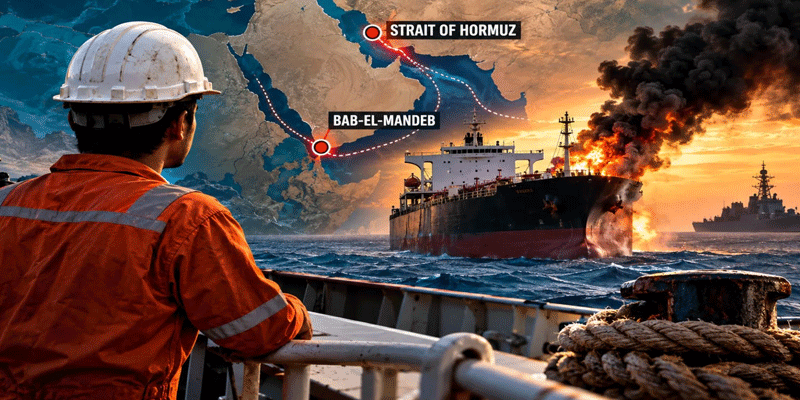
These waters carry energy supplies, manufactured goods and industrial inputs between the Middle East, Africa, Europe and East Asia. Disruptions caused by geopolitical tensions or damage to undersea infrastructure can increase freight costs, insurance premiums and delivery times.
This geography gives India an opportunity to combine maritime surveillance with commercial infrastructure and regional trade connectivity.
From ‘Future Fortress’ to Commercial Gateway
JD Patil, president of FINS, has described the islands as India’s “future fortress”, highlighting their strategic importance. However, their potential extends beyond defence and surveillance.
Possible commercial opportunities include:
· Transshipment: Transferring containers between vessels to serve regional markets.
· Ship repair: Providing maintenance and emergency services to passing vessels.
· Feeder shipping: Connecting smaller ports with major international shipping networks.
· Regional logistics: Supporting growing India–ASEAN trade, which reached approximately $128 billion in 2025–26, according to the figures provided.
Developing these activities could create employment, attract investment and strengthen India’s maritime links with Southeast Asia.
Great Nicobar Project: The Infrastructure Pivot
The proposed international container transshipment port at Galathea Bay, part of the Great Nicobar project estimated at around ₹90,000 crore, represents the most ambitious component of this vision.
The objective is to reduce India’s dependence on foreign transshipment hubs such as Singapore and Colombo while improving access to shipping routes near the Malacca Strait.
Separately, a ₹69,725-crore package for shipbuilding and the maritime sector, alongside investment commitments of approximately ₹12 lakh crore announced during India Maritime Week, could support shipbuilding, repair facilities, skilled employment and industrial supply chains.
Andaman Dialogue: Building Regional Partnerships
Scheduled for March 12–14, 2027, at Swaraj Dweep, the Andaman Dialogue is expected to bring together stakeholders from more than 15 countries. Discussions are planned around shipping networks, resilient infrastructure, maritime governance, ship repairs, undersea infrastructure and financial connectivity.
Greater information-sharing through the Information Fusion Centre–Indian Ocean Region could further strengthen regional maritime awareness and cooperation.
Turning Strategic Geography into Economic Strength
Despite its advantages, the island chain faces significant challenges, including infrastructure costs, environmental sensitivities, cargo availability, mainland connectivity and competition from established ports.
The real opportunity lies in integrating security with sustainable economic development. If India can deliver commercially viable ports, efficient logistics, environmental safeguards and dependable regional partnerships, the Andaman and Nicobar Islands could emerge as an important Indo-Pacific maritime hub. Otherwise, their strategic value may remain considerable while their wider economic potential remains underutilised.
(With agency inputs)