
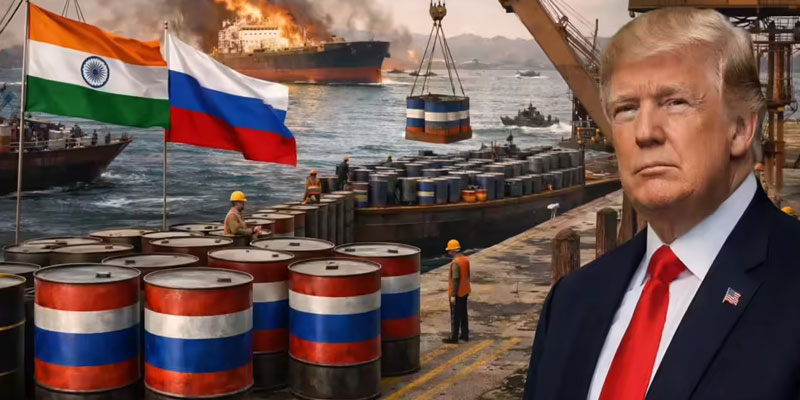
The United States is expected to extend a temporary waiver allowing continued purchases of Russian oil already in transit, a move aimed at cushioning global markets from the shock triggered by escalating conflict involving Iran. With tensions disrupting critical supply routes and threatening a sharp rise in fuel prices, the decision reflects Washington’s attempt to balance geopolitical strategy with urgent economic stability.
Conflict-Driven Oil Shock Reshapes Global Markets
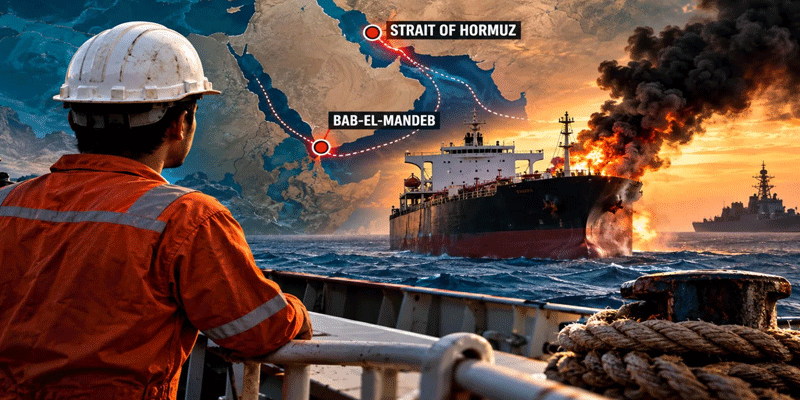
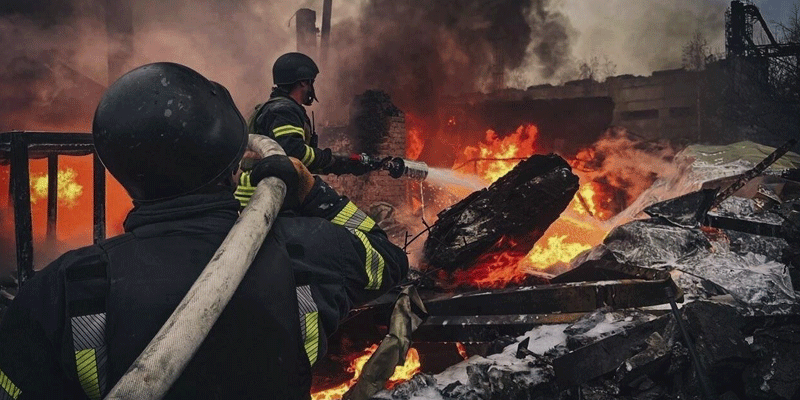
The ongoing US-Israeli confrontation with Iran has unleashed one of the most severe oil supply disruptions in modern history. The partial closure of the Strait of Hormuz—through which roughly one-fifth of global oil flows—has slashed Gulf production by over 10 million barrels per day. This sudden contraction has sent prices soaring and intensified volatility across energy markets.
In response, members of the International Energy Agency have coordinated the release of approximately 400 million barrels from strategic reserves. While this emergency measure offers temporary relief, it underscores the gravity of the crisis. Rising fuel costs are not only straining global economies but also posing domestic political risks in the United States, particularly ahead of key midterm elections.
Waiver Mechanics and Strategic Intent
Originally issued in mid-March, the waiver permits transactions involving Russian crude and petroleum products that were already at sea, effectively freeing up around 100 million barrels—nearly equivalent to a full day of global oil consumption. A similar waiver for Iranian oil followed shortly thereafter.
The proposed extension of this measure signals a pragmatic approach to managing supply shocks. By allowing these shipments to proceed, the US Treasury seeks to stabilize markets and prevent further price escalation. Officials have framed the strategy as a tactical maneuver to counter the unintended economic fallout of geopolitical conflict.
For major importers like India, the waiver is particularly significant. Access to relatively affordable Russian oil helps buffer against price spikes, offering some insulation from the broader turbulence in global energy markets.
Domestic Political Backlash Intensifies
Despite its economic rationale, the waiver has sparked bipartisan criticism in Washington. Republican lawmakers argue that such measures indirectly support adversarial nations, potentially undermining US national security. Concerns center on the possibility that continued oil revenues could bolster Iran’s regional ambitions and Russia’s ongoing military operations.
Democrats have also voiced opposition, introducing legislative efforts to terminate these waivers entirely. Proposed measures include stricter sanctions on entities involved in Russian oil trade and mechanisms to prevent future extensions. Critics contend that short-term economic relief should not come at the expense of long-term strategic objectives.
Strains with International Allies
The policy has also created friction with key US allies, particularly in Europe. European leaders have emphasized the importance of maintaining strict sanctions on Russia, viewing them as essential to limiting its capacity to sustain military actions. Any perceived relaxation risks weakening collective pressure and sending mixed signals about Western unity.
At the same time, countries heavily dependent on energy imports face a different reality. For them, the waiver provides a critical buffer against economic instability, highlighting the uneven impact of global crises and the challenge of aligning diverse national interests.
Strategic Trade-Offs in a Volatile Landscape
Extending the Russian oil waiver illustrates a broader dilemma in US policy: the need to reconcile immediate economic concerns with long-term geopolitical goals. While the move may help stabilize markets and ease domestic pressures, it also risks providing financial lifelines to rival powers during periods of conflict.
Ultimately, the decision reflects a shift toward pragmatic crisis management. Yet it raises important questions about the effectiveness of sanctions in a deeply interconnected world. As tensions persist and energy markets remain fragile, the balance between economic necessity and strategic discipline will continue to shape global responses to conflict.
(With agency inputs)