
A Rare Intervention Amid Global Turmoil
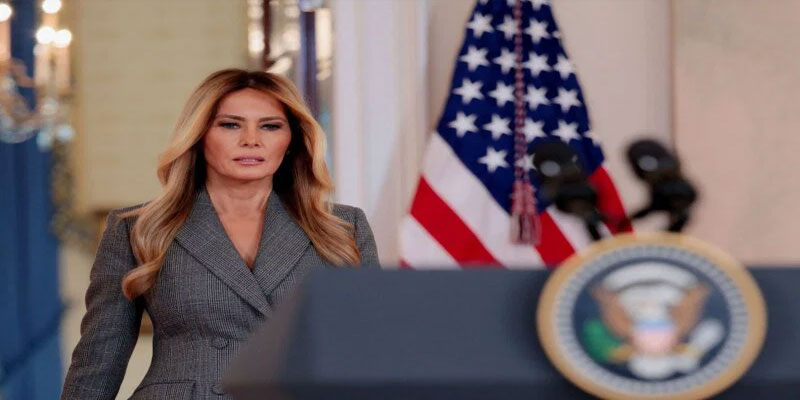
US First Lady Melania Trump delivered a rare public statement addressing long-circulating allegations linked to the late financier and convicted sex offender Jeffrey Epstein. In a brief but pointed five-minute address from the White House on April 9, 2026, she firmly denied any personal connection, calling such claims “lies” and urging that victims’ voices be heard through congressional hearings. The timing, however—amid escalating global conflicts and without any fresh allegations—has raised critical questions.
What Did Melania Trump Say?
In her remarks, Melania Trump rejected claims of any close association with Epstein, emphasizing that overlapping social circles in elite environments like New York and Palm Beach should not be misconstrued as personal ties. She also distanced herself from Epstein’s associate Ghislaine Maxwell and dismissed suggestions that Epstein played any role in her relationship with Donald Trump.
Notably, she called for congressional hearings to amplify the voices of victims—an appeal that aligns with broader public demands for transparency in Epstein-related investigations.
The Lingering Epstein Shadow
Epstein’s 2019 death in custody left a trail of unanswered questions, fueling conspiracy theories and ongoing scrutiny of powerful figures linked to him. Over the years, his network of associations has repeatedly resurfaced in political discourse, especially during election cycles.
During Donald Trump’s presidency and beyond, debates over the release of Epstein-related files have persisted. The issue has remained politically sensitive, with both parties facing pressure to address transparency and accountability.
Why Now? Timing Under the Microscope
Melania Trump’s decision to speak now—amid US-Iran tensions, Israeli military actions in Lebanon, and broader geopolitical instability—has sparked intense debate. With no new allegations or disclosures emerging, the timing appears unusual.
One explanation is the “distraction theory.” Critics argue that the statement shifts public attention away from ongoing geopolitical challenges and domestic political pressures faced by the administration. At a time when foreign policy decisions dominate headlines, reviving a controversial but familiar issue could redirect media focus.
Pre-emptive Defense or Genuine Frustration?
Another perspective suggests the move was pre-emptive. Persistent rumors and speculation may have reached a threshold where silence was no longer tenable. By addressing the issue directly, Melania Trump may be attempting to inoculate herself and her family against potential future revelations or renewed scrutiny.
Her advisor has framed the statement as a response to ongoing “lies,” positioning it as a personal defense rather than a political maneuver. The call for hearings also allows her to align with victims’ rights, potentially reframing the narrative in a more empathetic light.
Political and Strategic Implications
The statement has drawn mixed reactions. Supporters view it as a firm and necessary clarification, while critics see it as a calculated move consistent with the broader communication strategy often associated with Donald Trump—addressing controversies head-on to control the narrative.
It also places renewed pressure on lawmakers to act on Epstein-related investigations. If hearings materialize, they could reopen lines of inquiry that many political figures would prefer remain dormant.
For Melania Trump, who has largely maintained a low public profile, this marks a notable shift toward a more assertive role in public discourse.
A Calculated Move in a Complex Moment
Melania Trump’s Epstein statement underscores how unresolved controversies can resurface at politically sensitive moments. Whether driven by strategy or genuine frustration, the timing ensures maximum attention.
In a landscape dominated by global crises, the intervention serves as a reminder that domestic narratives remain deeply intertwined with political survival. As questions around Epstein continue to linger, this episode may be less about closure and more about shaping the narrative before it is shaped by others.
(With agency inputs)