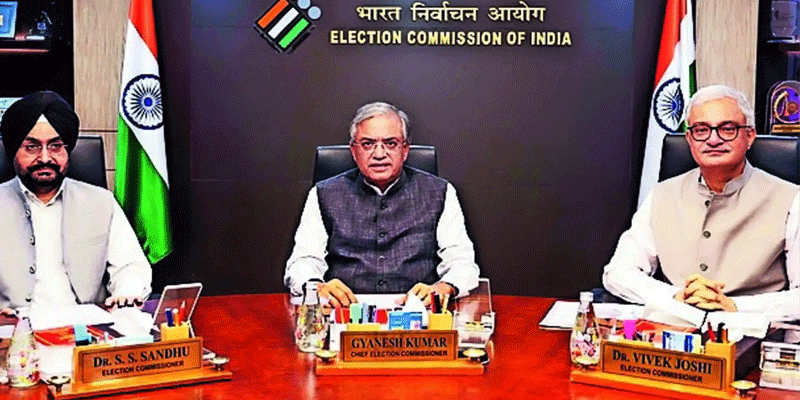

The Special Intensive Revision (SIR) of electoral rolls has emerged as one of the most contentious electoral exercises in recent years, triggering intense debates over voter rights, citizenship verification, and the integrity of democratic institutions. While critics argued that the exercise risked wrongful deletions and disenfranchisement, particularly among vulnerable communities, the Supreme Court has now upheld the Election Commission of India’s (ECI) authority to conduct SIR. At the same time, the Court has emphasized that the process must remain transparent, fair, and open to judicial scrutiny, reinforcing the delicate balance between electoral integrity and democratic participation.
Understanding SIR and Its Significance
The Special Intensive Revision is a focused exercise undertaken by the ECI to verify and update electoral rolls through measures such as field verification, document checks, and removal of ineligible entries. Unlike routine roll revisions, SIR is designed to identify inaccuracies on a larger scale and ensure that voter lists remain current and credible.
The exercise gained prominence in several states, including Bihar and West Bengal, where large-scale deletions and verification drives sparked concerns about potential exclusion of genuine voters. Civil society organizations, including the Association for Democratic Reforms (ADR), challenged aspects of the process, arguing that it lacked adequate transparency and could disproportionately affect migrants, economically weaker groups, and marginalized communities.
Given that electoral rolls form the foundation of democratic participation, the controversy quickly evolved into a broader debate about citizenship, documentation requirements, and institutional accountability.
Supreme Court Upholds ECI’s Authority
In its judgment, the Supreme Court reaffirmed that the Election Commission possesses the constitutional and statutory authority to conduct SIR. The bench held that powers relating to the preparation, revision, inclusion, and deletion of names from electoral rolls flow from Article 324 of the Constitution and the provisions of the Representation of the People Act, 1950.
The Court made it clear that SIR, as a mechanism for maintaining accurate voter lists, cannot be struck down merely because errors or implementation challenges may arise during its execution. According to the bench, accurate electoral rolls are an essential prerequisite for free and fair elections and therefore fall squarely within the Commission’s mandate.
By recognizing voter list revision as an integral part of the electoral process, the Court effectively strengthened the ECI’s institutional authority while reaffirming the constitutional importance of credible elections.
Citizenship Concerns and Due Process
One of the most sensitive aspects of the litigation involved concerns that SIR could become an indirect citizenship verification exercise. Petitioners argued that excessive reliance on documents could result in eligible voters being excluded from electoral rolls.
The Court addressed these concerns by clarifying that while the ECI may examine eligibility questions and act where doubts arise, any deletion must follow due process. Individuals must be given opportunities to respond, submit supporting documents, seek corrections, and pursue appeals where necessary.
Importantly, the bench reiterated that documents such as Aadhaar cannot by themselves establish citizenship. It cautioned against mechanical decision-making and stressed that technology and database matching should support—not replace—human judgment and procedural fairness.
Safeguards, Accountability and Judicial Review
While upholding the legality of SIR, the Court underscored that the entire process remains subject to judicial review. Allegations of arbitrariness, discrimination, wrongful deletions, or misuse of statutory procedures can still be challenged before courts.
The judgment also places a responsibility on the ECI to ensure transparency, wider acceptance of valid documents, reasonable timelines, and effective grievance redressal mechanisms. In essence, the Court has preserved the Commission’s authority while insisting that electoral integrity cannot come at the expense of fairness and inclusion.
Balancing Integrity and Inclusion
The Supreme Court’s ruling represents a carefully calibrated middle path. It affirms that the Election Commission has the power—and indeed the responsibility—to keep electoral rolls accurate and updated, a cornerstone of free and fair elections. Yet it also makes clear that such authority is not absolute. Procedural safeguards, transparency, and judicial oversight remain essential protections against exclusion and misuse. The judgment therefore reinforces a fundamental democratic principle: credible elections require both accurate voter lists and an unwavering commitment to protecting every eligible citizen’s right to vote.
(With agency inputs)