
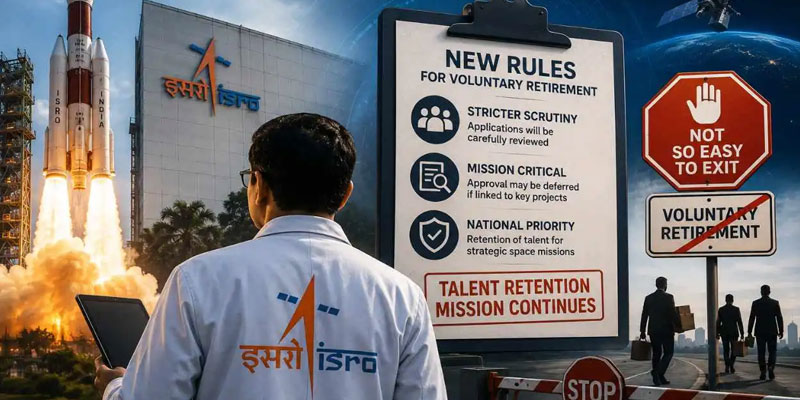
India has tightened exit rules for scientists of the Indian Space Research Organisation (ISRO) associated with Gaganyaan and other strategically important missions, amid reports of an exodus of experienced personnel from key space centres. The move reflects the government's growing recognition that retaining specialised scientific talent is as critical to national space ambitions as technological innovation itself. By placing stricter controls on resignations and voluntary retirements, India aims to safeguard mission continuity and protect invaluable institutional expertise during a crucial phase of its expanding space programme.
ISRO: Driving India's Expanding Space Ambitions
The Indian Space Research Organisation (ISRO) is the country's premier space agency, responsible for designing and executing satellite launches, planetary exploration, Earth observation, navigation systems, communication satellites and launch vehicle development. Over the decades, ISRO has established itself as one of the world's most cost-effective and reliable space agencies, delivering landmark missions such as Chandrayaan and Mangalyaan.
Its current flagship programme, Gaganyaan, India's first human spaceflight mission, represents a major technological leap. Alongside human spaceflight, ISRO is also pursuing advanced satellite systems, reusable launch technologies, deep-space exploration and commercial space services, making the continuity of highly skilled scientific teams increasingly vital.
Government Tightens Exit Approval Process
According to reports published on July 15–16, 2026, the Department of Space issued an internal memorandum dated July 14 directing all ISRO centres not to routinely approve resignations or voluntary retirement requests from Group A scientific and technical personnel working on Gaganyaan and other strategically significant programmes.
Under the revised framework, such requests will no longer be decided solely by the directors of individual ISRO centres. Instead, every case must be referred to the Department of Space for final approval. This marks a reversal of the 2020 policy, under which centre directors were empowered to approve resignations and voluntary retirements up to the Scientist/Engineer-SG level.
The decision effectively centralises personnel management for mission-critical projects, reflecting a more cautious approach to protecting specialised human resources.
Why the Government Intervened
The policy change follows concerns over a reported rise in departures from two of ISRO's most critical establishments—the U. R. Rao Satellite Centre (URSC) in Bengaluru and the Vikram Sarabhai Space Centre (VSSC) in Thiruvananthapuram.
Media reports, citing ISRO sources, indicate that nearly 100–120 scientists may have left these centres in recent months, including around 80 from URSC and approximately 20 from VSSC. While the Department of Space has not officially confirmed these figures, the reports have raised concerns about the loss of highly experienced personnel possessing specialised project knowledge accumulated over years of mission development.
Unlike routine vacancies, departures from strategic programmes can disrupt engineering continuity, systems integration, design validation and mission planning, where experience often cannot be replaced quickly through fresh recruitment.
Strategic Importance Beyond Human Resource Management
Large-scale space missions require seamless coordination among experts in propulsion, avionics, spacecraft design, mission planning, software integration, testing and launch operations. Every phase depends on accumulated institutional knowledge and close collaboration among multidisciplinary teams.
By centralising approvals for resignations, the government is signalling that scientific expertise in strategic programmes constitutes a national asset. The decision also reflects the growing competition for skilled aerospace professionals as India's private space sector expands, creating attractive career opportunities outside the public sector.
While ISRO leadership has maintained that ongoing missions remain on schedule, the latest order demonstrates a proactive effort to minimise risks arising from talent attrition during mission-critical stages.
Protecting Human Capital, Protecting National Missions
India's latest policy underscores an important shift in its approach to space governance—from merely expanding technological capabilities to actively safeguarding the human expertise that powers them. As ambitious missions such as Gaganyaan move closer to execution and India's space ecosystem becomes increasingly competitive, retaining experienced scientists will remain essential for ensuring mission success, technological self-reliance and long-term strategic leadership in the global space arena.
(With agency inputs)