
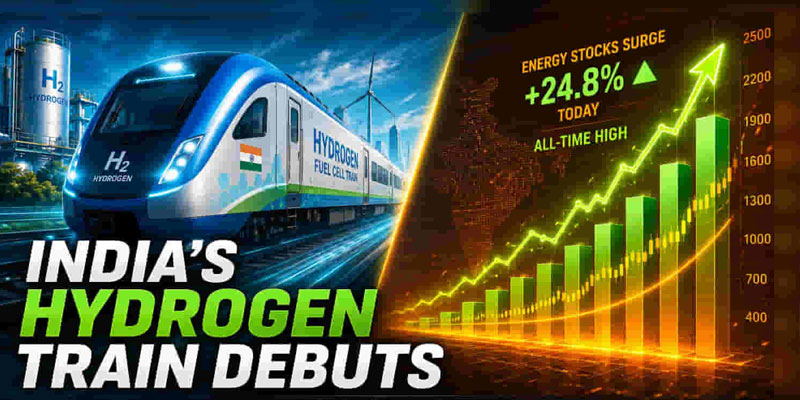
A Milestone in India's Green Rail Transformation
India has entered a new era of sustainable transportation with the launch of its first hydrogen-powered passenger train on the Jind–Sonipat route in Haryana. Flagged off by Prime Minister Narendra Modi, the train marks a major milestone in Indian Railways' transition towards cleaner mobility and reinforces the country's ambition to develop indigenous green technologies. More than just a technological achievement, the project represents a pilot for zero-emission rail transport that could eventually complement railway electrification and help India achieve its goal of net-zero carbon emissions by 2030.
The Push Towards Cleaner Rail Transportation
Indian Railways has steadily pursued one of the world's largest railway electrification programmes as part of its commitment to becoming a net-zero carbon emitter by 2030. However, several regional and non-electrified routes continue to depend on diesel-powered trains, making them significant contributors to carbon emissions and local air pollution.
Hydrogen fuel-cell technology offers an alternative solution for such routes. Instead of burning diesel, hydrogen combines with oxygen inside fuel cells through an electrochemical process to generate electricity, producing only water vapour and heat as by-products. The technology eliminates local emissions of carbon dioxide, nitrogen oxides, sulphur oxides and particulate matter while offering operational flexibility for routes where overhead electrification may not be economically viable.
Having already witnessed successful deployments of hydrogen trains in parts of Europe and Asia, India has now joined the emerging group of nations investing in zero-emission rail propulsion.
India's First Hydrogen Train: Design and Operations
The new train has been indigenously designed and manufactured by the Integral Coach Factory (ICF), Chennai. It consists of a 10-coach formation comprising two Hydrogen Driving Power Cars and eight passenger coaches.
With a total capacity of approximately 2,600 passengers, including around 682 seats and extensive standing accommodation, it is among the highest-capacity hydrogen-powered passenger trains currently in service worldwide.
The train will operate on the 89-kilometre Jind–Sonipat route under Northern Railway, completing two round trips every day and covering nearly 356 kilometres daily. While its operational speed is approved at 75 kmph, it has been engineered for a design speed of 110–120 kmph, providing scope for future operational enhancements.
How Hydrogen Fuel-Cell Technology Works
The train is powered by hydrogen fuel-cell propulsion units generating nearly 1,200 kilowatts per power car, delivering a combined output of roughly 3,200 horsepower. Hydrogen stored in onboard tanks reacts with oxygen inside fuel cells to generate electricity, which powers the traction motors.
Battery systems complement the fuel cells by managing fluctuating power demand and storing energy recovered during regenerative braking, thereby improving efficiency.
Unlike conventional diesel locomotives, the process involves no combustion, resulting in zero tailpipe emissions apart from water vapour. The train can travel approximately 250 kilometres on a single refuelling cycle, making it well suited for regional passenger services and providing a scalable model for other short- and medium-distance routes.
A Symbol of Indigenous Innovation and Green Mobility
The inauguration formed part of a broader package of railway projects, including redeveloped Amrit Bharat stations in Haryana and Punjab. Beyond its operational significance, the hydrogen train has been positioned as a "swadeshi" technological achievement, highlighting India's growing capability to design, engineer and integrate advanced clean mobility solutions domestically.
The project also reinforces India's broader climate commitments while showcasing its ability to combine infrastructure expansion with technological innovation.
From Demonstration Project to Sustainable Rail Revolution
The successful deployment of India's first hydrogen-powered train represents an important proof of concept rather than the final destination. Its long-term success will depend on operational reliability, competitive lifecycle costs, stringent safety standards and, crucially, the development of a robust green hydrogen ecosystem, including production facilities and refuelling infrastructure.
If these complementary elements evolve alongside continued railway modernisation, hydrogen-powered trains could become an effective solution for decarbonising routes where full electrification remains difficult or uneconomical. In doing so, India would not only reduce its transport emissions but also position itself as a leader in indigenous clean mobility technologies, demonstrating how innovation and sustainability can move forward on the same track.
(With agency inputs)