
Shares Slip as US Law Firms Examine Disclosure Practices
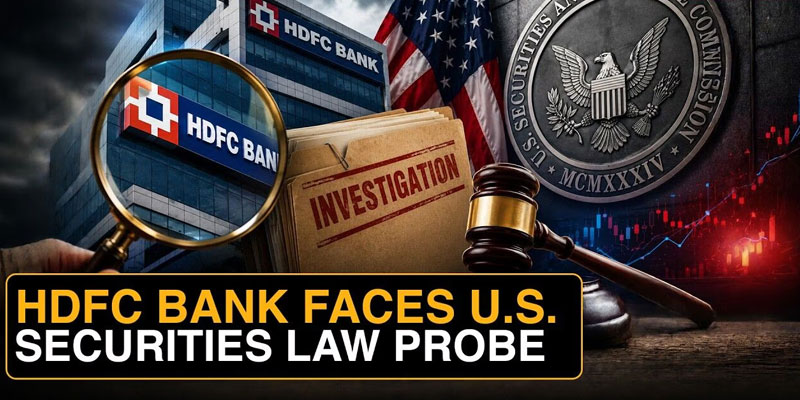
HDFC Bank shares remained under pressure after several US-based shareholder law firms launched investigations into the bank's investor disclosures, following allegations linked to payments made to the Maharashtra State Road Development Corporation (MSRDC). While no regulatory action or formal charges have been announced, the episode has heightened investor concerns over corporate governance, financial transparency and potential cross-border litigation risks, weighing on market sentiment.
Allegations That Triggered the Scrutiny
The controversy stems from a media investigation published on May 27, which alleged that HDFC Bank paid nearly ₹45 crore to the Maharashtra State Road Development Corporation (MSRDC) as higher interest on institutional deposits. According to the report, these payments were allegedly recorded under marketing and sponsorship expenses associated with a road-safety campaign.
The allegations raised questions over whether the true nature of these payments was adequately disclosed to investors, prompting legal scrutiny from shareholder-rights firms in the United States.
US Shareholder Law Firms Begin Preliminary Investigations
In late July, at least three prominent US shareholder law firms—Glancy Prongay Wolke & Rotter LLP, Law Offices of Howard G. Smith, and Law Offices of Frank R. Cruz—announced investigations on behalf of HDFC Bank investors.
The firms are examining whether the bank or certain executives may have:
· Issued materially misleading statements to investors.
· Failed to disclose significant information relating to the MSRDC-linked payments.
· Violated provisions of US federal securities laws.
· Exposed investors to financial losses through alleged disclosure deficiencies.
The firms have also invited investors who incurred losses to come forward as they assess the feasibility of filing class-action lawsuits. Importantly, these investigations remain preliminary and do not amount to regulatory findings or legal charges.
Market Reaction Reflects Investor Caution
The announcements triggered fresh selling pressure on the stock.
Key market developments include:
· HDFC Bank shares declined by over 1% in early trade on July 24.
· The stock traded in the ₹737–₹740 range.
· Shares had already fallen nearly 10% over the previous five trading sessions following the bank's first-quarter earnings.
· HDFC Bank's American Depositary Receipts (ADRs) had earlier declined by about 4.1%, a movement cited by the law firms while assessing potential investor losses.
Although the bank has denied any wrongdoing or has not commented further on the investigations, uncertainty has continued to influence investor sentiment.
Governance Concerns Go Beyond the Alleged Payments
From an analytical perspective, the controversy carries implications extending well beyond the disputed ₹45 crore.
Key issues include:
· Corporate governance: Allegations surrounding accounting classification have renewed scrutiny of disclosure standards and internal financial controls.
· Cross-border litigation risk: Investigations by US shareholder law firms increase reputational and legal risks for a bank with significant international investors and ADR listings.
· Valuation pressure: The combination of softer quarterly earnings, governance-related headlines and potential litigation could prompt investors to demand a higher risk premium, affecting the bank's valuation despite the absence of regulatory action.
Trust and Transparency Will Shape Investor Confidence
At present, HDFC Bank faces more of a perception challenge than an immediate legal crisis. The investigations are still exploratory, and no enforcement agency has accused the bank of violating securities laws.
However, for one of India's largest private-sector banks, maintaining investor confidence depends as much on transparency as on financial performance. A clear explanation of the MSRDC-related disclosures, coupled with strong governance practices, will be crucial in restoring market confidence and limiting the long-term impact of this episode on the bank's reputation and valuation.
(With agency inputs)