
Supreme Court Steps in Amid Explosive Allegations
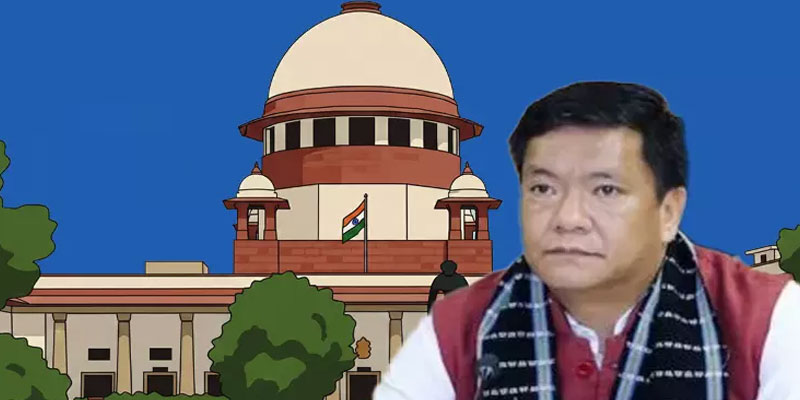
In a significant development, the Supreme Court of India has ordered a preliminary probe by the Central Bureau of Investigation into alleged irregularities in awarding public works contracts worth ₹1,270 crore to firms linked to the family of CM Pema Khandu. The directive, issued by a bench comprising Justice Vikram Nath, Justice Sandeep Mehta, and Justice NV Anjaria, mandates scrutiny of contracts awarded between 2015 and 2025. A status report is expected within 16 weeks to determine whether a full-fledged investigation is warranted.
The PIL and Allegations of Cronyism
The case originates from a Public Interest Litigation filed by the Save Mon Region Federation and Voluntary Arunachal Sena. The petition alleges systemic favoritism in the allocation of government contracts, claiming that nearly 3% of all state projects were awarded to just four firms connected to the Khandu family.
Senior advocate Prashant Bhushan, representing the petitioners, argued that the pattern of awards “reek of corruption.” He raised concerns about the impartiality of local law enforcement, advocating for an independent probe by either the CBI or a Special Investigation Team. Supporting the claims, reports from the Comptroller and Auditor General of India highlighted instances of non-competitive bidding, including dozens of contracts awarded without proper tendering.
Contracts, Firms, and Questionable Processes
The contracts under scrutiny span a wide range of public infrastructure projects, particularly road construction and restoration in districts such as Tawang. Of the total ₹1,270 crore, approximately ₹1,245 crore was awarded through tenders, while ₹25 crore was reportedly allocated directly.
Firms implicated include M/s Frontier Associates and M/s Brand Eagles—linked to Khandu’s immediate family—as well as entities associated with his brother and other relatives. In Tawang alone, these firms reportedly secured 146 contracts worth ₹383.74 crore between 2012 and 2023. Some of these were allegedly granted without competitive bidding under the pretext of “local compensation,” raising red flags about transparency and fairness.
Government’s Stand and Political Silence
While no immediate public response from Pema Khandu followed the court’s latest order, the state government has previously denied all allegations. During earlier hearings, counsel for Arunachal Pradesh dismissed the claims as baseless, asserting that there were no irregularities in the contract allocation process.
Affidavits submitted to the court detailed the procedures followed, attempting to demonstrate compliance with established norms. However, the persistence of audit concerns and judicial scrutiny suggests that questions over governance remain unresolved.
Wider Governance and Political Implications
The probe has broader implications for governance in Arunachal Pradesh. It revives earlier concerns flagged by the CAG, including similar issues linked to projects during the tenure of Khandu’s late father. Transparency in public procurement and the disclosure of potential conflicts of interest are now under renewed focus.
Politically, the case could have ramifications for the ruling establishment, particularly as it underscores the judiciary’s role in enforcing accountability. Depending on the findings of the preliminary inquiry, the matter could either escalate into a full-scale investigation or result in closure, shaping public perception and administrative credibility.
A Crucial Moment for Public Trust
The Supreme Court’s intervention marks a critical moment in the intersection of governance, accountability, and judicial oversight. While the probe is only at a preliminary stage, it signals that allegations of favoritism in public contracts will face rigorous scrutiny. The outcome will not only determine the fate of the specific case but also set a precedent for transparency in state-level administration.
(With agency inputs)