
A Manifesto Framing the 2026 Contest
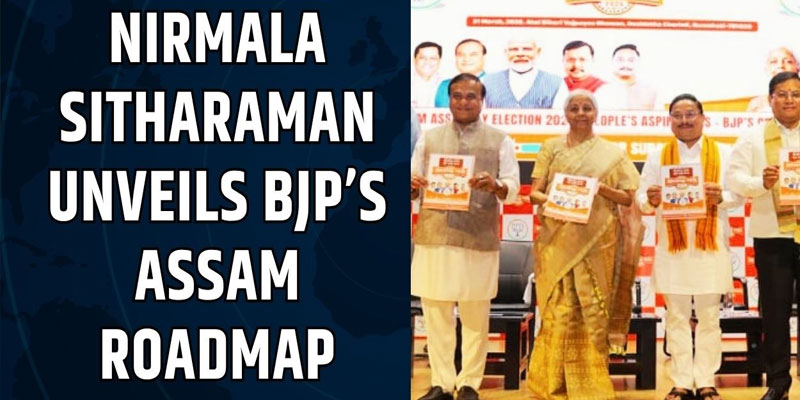
The Bharatiya Janata Party has laid out an ambitious 31-point manifesto for the 2026 Assam Assembly elections, blending identity politics with development-driven promises. Released in Guwahati by Chief Minister Himanta Biswa Sarma and Union Finance Minister Nirmala Sitharaman, the document positions the party as both a protector of Assamese identity and a driver of economic transformation. From implementing a Uniform Civil Code to making Assam flood-free, the manifesto seeks to strike a balance between ideological commitments and governance priorities.
UCC and Immigration: Core Political Messaging
At the heart of the manifesto lies the promise to implement a Uniform Civil Code (UCC) in Assam, with exemptions for tribal communities. This reflects a calibrated approach—pushing a key ideological agenda while acknowledging the sensitivities of Sixth Schedule areas. Alongside this, the BJP has doubled down on its stance against illegal immigration.
The party has pledged strict enforcement of the Immigrants (Expulsion from Assam) Act, 1950, which allows authorities to act swiftly against undocumented individuals. This aligns with its long-standing narrative of safeguarding indigenous identity, particularly in regions vulnerable to demographic shifts. The emphasis on eviction drives and land protection signals a continuation—and possible intensification—of policies that have already shaped Assam’s political discourse.
Welfare Expansion and Employment Push
Beyond identity politics, the manifesto places significant focus on welfare and economic opportunity. A key promise is the expansion of women-centric Direct Benefit Transfer schemes, building on the existing model. By extending financial support to an additional 15 lakh households, the BJP aims to deepen its outreach among low-income families, particularly women.
Employment generation is another major pillar. The party has committed to creating two lakh government jobs over five years, alongside promoting self-employment through state-led initiatives. These measures are framed within a broader vision of transforming Assam into a growth hub capable of attracting investment and even reversing talent migration.
The emphasis on ongoing industrial projects, including major infrastructure and energy developments, reinforces the narrative that Assam is already on a high-growth trajectory—one the BJP promises to accelerate further.
Flood-Free Assam: A Defining Promise
Perhaps the most tangible and high-impact commitment in the manifesto is the pledge to make Assam flood-free. With an investment plan exceeding ₹18,000 crore, the proposed “Badh Mukt Assam Mission” aims to address one of the state’s most persistent challenges.
The strategy includes strengthening embankments, systematic dredging of the Brahmaputra, and improved river management systems. Additionally, the creation of a dedicated volunteer force to monitor flood infrastructure reflects an attempt to combine large-scale engineering with community participation.
By linking flood control to broader infrastructure initiatives under its development agenda, the BJP is attempting to reframe a recurring crisis as an opportunity for long-term state-building.
A Dual Strategy for Voters
The BJP’s Assam manifesto presents a carefully constructed dual strategy—combining assertive identity politics with expansive development promises. It seeks to appeal to voters’ concerns over cultural preservation while offering solutions to economic and environmental challenges.
However, the success of this approach will depend on execution. Policies on immigration and identity remain politically sensitive, while ambitious infrastructure goals like flood control require sustained investment and effective implementation.
Ultimately, the manifesto sets the stage for an election centered not just on ideology, but on delivery. Voters will now have to weigh whether the BJP’s vision can translate into tangible improvements on the ground, or whether its promises remain aspirational in a complex and diverse state like Assam.
(With agency inputs)