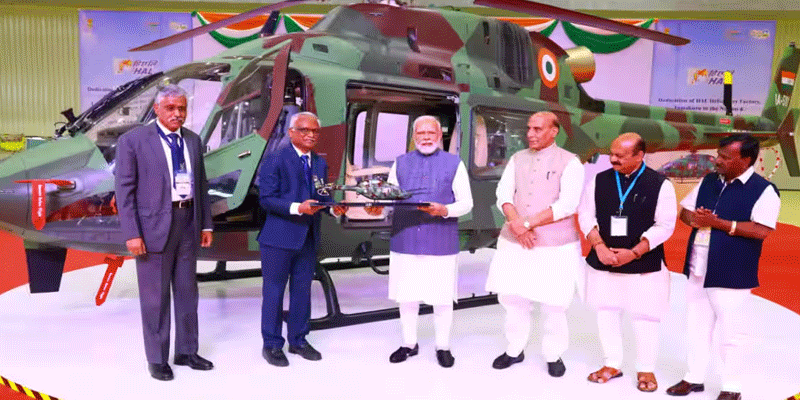

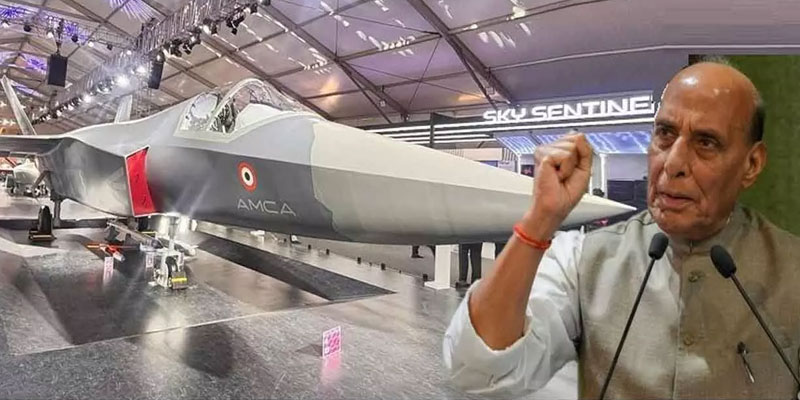
Union Defence Minister Rajnath Singh and Andhra Pradesh Chief Minister N. Chandrababu Naidu laid the foundation stone for the ₹15,803-crore Advanced Medium Combat Aircraft (AMCA) infrastructure project in Puttaparthi on May 15, 2026, marking a major step in India’s indigenous defence modernisation programme. The project, spread across 650 acres in Sri Sathya Sai district, will house the AMCA Core Integration and Flight-Testing Centre and is expected to become one of the country’s most strategic aerospace facilities. Developed under the Aeronautical Development Agency (ADA), affiliated with DRDO, the initiative strengthens India’s ambition to develop its first indigenous fifth-generation stealth fighter aircraft.
The event also reflected the Centre’s broader push to make India self-reliant in advanced defence manufacturing under the Atmanirbhar Bharat vision. Alongside the AMCA project, several new defence manufacturing facilities were announced across Andhra Pradesh, including naval systems, ammunition, drone, and energetics production units.
Why the AMCA Programme Is Historically Significant
The AMCA programme is considered a transformational leap for India’s military aviation capability. Unlike earlier fighter programmes, the AMCA is designed as a fifth-generation stealth aircraft with advanced low-observable features, multi-role combat ability, and all-weather operational capacity. The aircraft is expected to possess sophisticated avionics, electronic warfare systems, and precision strike capabilities that can compete with some of the world’s most advanced fighter jets.
Its importance lies not only in technological advancement but also in strategic autonomy. Only a handful of nations currently possess the capability to design and test fifth-generation stealth fighters. With the AMCA project, India aims to enter that exclusive global league and reduce long-term dependence on foreign defence imports.
How the Project Could Transform the Region
The AMCA infrastructure project is expected to dramatically reshape the economic and industrial landscape of Andhra Pradesh, particularly the Rayalaseema region. Traditionally viewed as drought-prone and economically underdeveloped, the area is now being positioned as a future defence and aerospace manufacturing hub.
The project alone is expected to generate around 7,500 direct high-skilled jobs, while indirect employment opportunities through ancillary industries, logistics, engineering services, and manufacturing support are likely to be far greater. The state government also expects local MSMEs, engineering colleges, ITIs, and research institutions to become integrated into the emerging defence ecosystem.
Chief Minister Chandrababu Naidu highlighted the rapid 36-day approval process as evidence of Andhra Pradesh’s commitment to attracting advanced industries. If successfully implemented, the project could trigger broader urban development, infrastructure expansion, and technological investment across the region.
Strengthening Atmanirbhar Bharat in Defence
The AMCA initiative strongly reinforces the Atmanirbhar Bharat vision in defence manufacturing. Rajnath Singh emphasized that self-reliance in defence is essential in an era of global uncertainty and geopolitical tension. India’s defence production has already risen significantly—from ₹46,000 crore in 2014 to over ₹1.54 lakh crore in 2026—while defence exports have surged to nearly ₹40,000 crore.
The simultaneous launch of drone manufacturing hubs, naval systems facilities, and ammunition plants demonstrates a coordinated effort to create a complete domestic defence production chain. This approach reduces strategic dependence on imports while promoting indigenous innovation and private-sector participation.
A Crucial Step Toward Strategic Self-Reliance
The AMCA project represents far more than the development of a fighter jet. It symbolizes India’s determination to emerge as a technologically advanced and strategically self-reliant defence power. By combining indigenous innovation, regional industrial growth, and national security priorities, the initiative has the potential to redefine both India’s aerospace capabilities and Andhra Pradesh’s economic future.
(With agency inputs)