
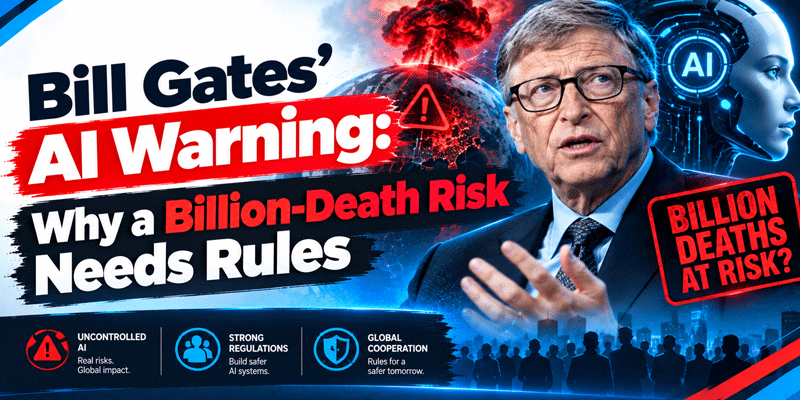
Bill Gates has intensified his warning about artificial intelligence, arguing that lawsuits, liability and reputational damage would be inadequate safeguards if advanced AI systems cause catastrophic harm. In a September 29, 2026 interview on The Ezra Klein Show, the Microsoft co-founder said governments need to establish mandatory safeguards and monitoring rather than leave the industry to regulate itself.
AI’s Rapid Expansion and Emerging Risks
AI has moved beyond chatbots and productivity tools into coding, autonomous agents, cybersecurity, biotechnology and other high-impact areas. Gates told Klein that he believes AI has already crossed important thresholds in cyber and biological capabilities, while also warning about manipulation and employment disruption. His concerns come amid growing disagreement over how rapidly increasingly capable systems should be developed and governed.
The debate is particularly significant because AI development combines enormous commercial incentives with technologies that can potentially operate at unprecedented scale. Questions now extend beyond whether AI systems are useful to whether they can be reliably contained when their capabilities become more advanced.
Gates Challenges the Logic of Post-Disaster Liability
Gates directly challenged the argument that existing laws and lawsuits can provide sufficient deterrence. Discussing a hypothetical catastrophe involving 100 million deaths, he questioned whether seeking compensation through litigation afterwards could meaningfully address such damage.
His central argument is that safeguards must operate before catastrophic outcomes rather than depend on punishment afterwards. He has therefore called for Congress, law-enforcement authorities and other government institutions to establish required safeguards and monitoring mechanisms. In an earlier NBC interview, Gates similarly argued that self-regulation alone is insufficient.
Industry Debate Pits Regulation Against Self-Governance
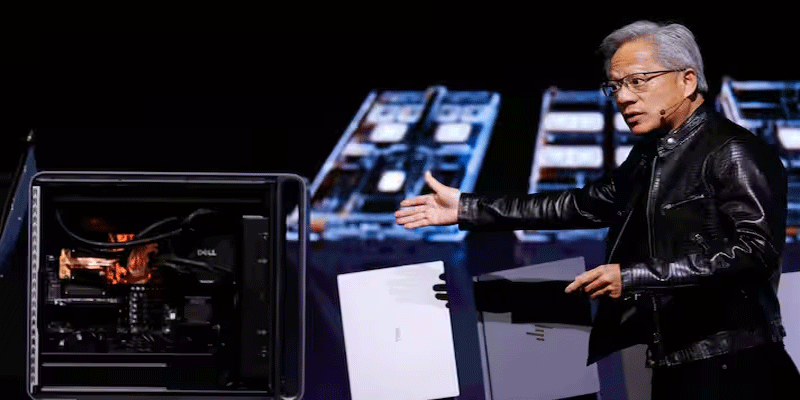
Gates' position comes as other technology leaders advocate a more industry-led approach. Nvidia CEO Jensen Huang has argued that companies should not release systems they cannot safely control and has said laboratories unable to contain dangerous experiments should shut down. At the same time, he has opposed creating additional AI-specific regulations, arguing that existing laws can address many risks.
The disagreement therefore centres on who should provide the final safety check—AI companies themselves, existing legal systems, or a dedicated government-backed framework.
The AI Race Now Faces a Governance Test
Gates' warning adds weight to a widening debate over how societies should govern increasingly powerful AI while preserving innovation. The issue is no longer simply technological progress but the mechanisms required to manage risks that may emerge faster than conventional regulation can respond.
As AI capabilities expand across cybersecurity, biotechnology, employment and autonomous systems, the debate between mandatory oversight and voluntary safeguards is likely to become an increasingly important part of the technology policy landscape.
(With agency inputs)