
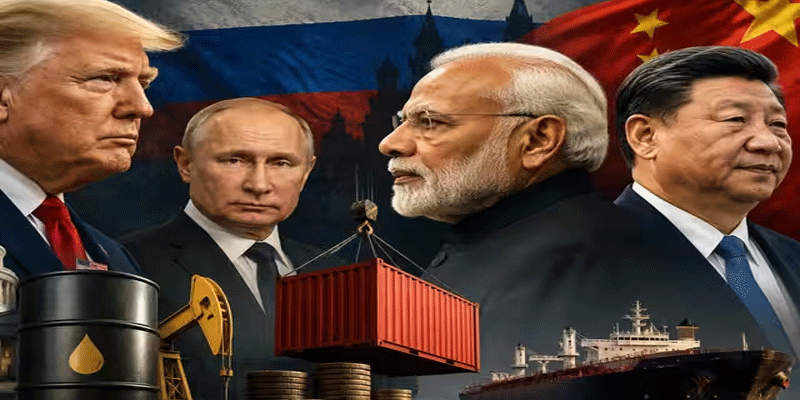
The US Russia sanctions bill raises a new tariff risk for India as Washington moves to intensify economic pressure on Moscow. The measure could give President Donald Trump authority to impose tariffs of up to 100% on countries that continue major purchases of Russian oil and gas, placing India and China among the economies facing potential exposure.
US House Advances Sweeping Russia Sanctions
The Republican-led US House of Representatives passed the Lindsey O. Graham Sanctioning Russia and Iran Act of 2026 on September 16 by 262 votes to 159, following its earlier passage in the Senate by 86-11. The legislation now moves to President Trump for approval.
The bill seeks to strengthen sanctions against Russian officials, financial institutions, defence interests, energy-related entities and the so-called Russian “shadow fleet” of tankers. Its most consequential provision would allow the President to impose tariffs of up to 100% on imports from countries continuing to purchase significant quantities of Russian petroleum or natural gas.
Importantly, the bill does not automatically impose a 100% tariff on India or China. It creates statutory authority for the President to use such tariffs if the relevant conditions are met and the administration decides to act.
India, China to Face New Trump Tariffs?
India and China are particularly exposed because both remain major buyers of Russian crude. The legislation therefore creates a potential conflict between Washington's Russia policy and the energy requirements of two major trading partners.
Key implications include:
· India: Higher US tariffs could affect Indian exports and increase pressure on sectors dependent on access to the American market.
· China: Its large Russian energy purchases could similarly bring Chinese exports under additional US tariff pressure.
· Russia: The measure seeks to reduce Moscow's energy revenues by discouraging major economies from purchasing its hydrocarbons.
· US trade policy: The legislation expands the President's statutory ability to use tariffs as an instrument of foreign policy.
The measure has also generated debate in Washington, with some Democrats supporting stronger pressure on Russia while objecting to the breadth of additional tariff powers granted to the President.
India Puts Energy Security at The Centre
New Delhi has responded by emphasising energy security rather than announcing any immediate change in Russian oil purchases. The Ministry of External Affairs said India remains committed to ensuring energy security for its 1.4 billion people through diversified sourcing and decisions based on evolving market conditions. It also said India would take necessary measures to protect its economic and trade interests.
Russian crude became an important component of India's energy mix after 2022, when discounted supplies helped Indian refiners manage costs. Any abrupt reduction could increase dependence on alternative suppliers and expose India to higher or more volatile international energy prices.
Tariff Threat Creates a Difficult Balancing Act
For India, the challenge extends beyond crude procurement. A broad US tariff could affect export competitiveness, trade flows and investment sentiment, while replacing Russian energy rapidly could increase India's import bill.
At the same time, India has consistently pursued diversification across energy suppliers and sources, making flexibility central to its energy strategy.
Energy Security and Trade Interests Now Intersect
The immediate issue is therefore tariff risk, not an automatic 100% duty. India is likely to watch the legislation's implementation closely while engaging Washington and maintaining diversified energy procurement. The episode highlights a wider challenge: India's strategic relationship with the US is expanding even as its energy relationship with Russia remains significant. How New Delhi manages that intersection could influence both its trade environment and energy costs in the months ahead.
(With agency inputs)