
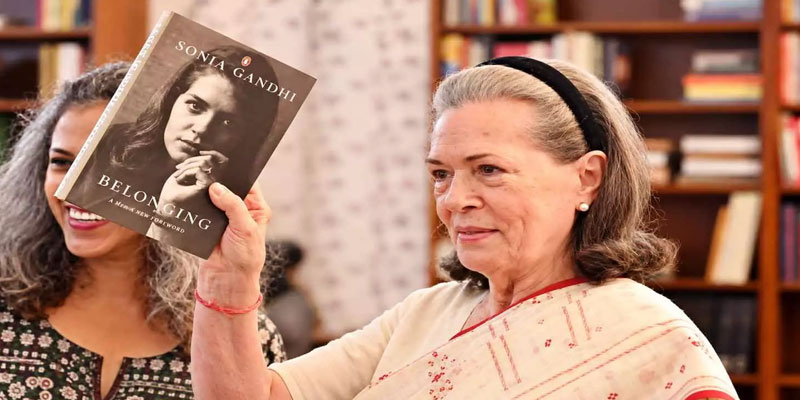
Sonia Gandhi’s new memoir, belonging: A Journey of Love, released on November 10, 2026, combines deeply personal recollections of family tragedies with a critical assessment of India's political transformation. From grenades and assassination threats to grief, political power and ideological differences, the book traces her journey from post-war Italy to the centre of Indian politics. It also presents a sharp critique of Prime Minister Narendra Modi's era, Hindu nationalism and what she describes as the shrinking space for dissent in India.
A Memoir Amid Political and Publishing Controversy
Published by HarperCollins India, the book offers an account of India's political, economic and social evolution over five decades. Although Gandhi describes it as a personal narrative rather than a conventional political statement, its contents have given it considerable political significance.
Its publication followed reports of disagreements with Penguin Random House India over references to Modi, the RSS, communal violence and minority rights. The manuscript eventually moved to HarperCollins, making the publishing dispute another significant chapter surrounding its release.
Family Tragedies, Assassinations and Personal Loss
One of the memoir's most emotional threads is the Gandhi family's history of violence and bereavement. Sonia recalls losing her first child shortly after birth, the assassination of her mother-in-law, former Prime Minister Indira Gandhi, by her Sikh bodyguards in 1984, and the killing of her husband, former Prime Minister Rajiv Gandhi, in 1991.
She also revisits Operation Blue Star and the discovery of grenades in a room of the family residence, reflecting the atmosphere of insecurity surrounding the family during the turbulent 1980s.
These experiences shaped her eventual entry into politics. She suggests that Rajiv Gandhi's assassination and the personal devastation that followed fundamentally changed her relationship with public life.
Political Journey: From Reluctance to Power
The memoir revisits several defining moments in India's political history, including the Emergency of 1975-77, Operation Blue Star, Sonia Gandhi's decision to acquire Indian citizenship and the Congress-led United Progressive Alliance's victory in 2004.
A particularly significant chapter concerns her decision to decline the prime ministership in 2004 and support Dr Manmohan Singh for the position. Gandhi explains that she considered him a leader of integrity with a deep understanding of governance. She also acknowledges that Congress's political failures contributed to the BJP's subsequent rise and the expansion of Hindutva politics.
Modi And the Ideological Battle
Gandhi describes her relationship with Modi as distant, claiming there has been practically no meaningful personal interaction between them. She presents their differences as a clash between competing visions of India.
Her arguments focus on:
· Secularism, pluralism and constitutional institutions.
· Protection of minorities and India's cultural diversity.
· Concerns over declining democratic freedoms and press accountability.
These are Gandhi's political assessments, reflecting her interpretation of the country's direction under the Modi government.
BJP's Counterattack: Emergency and Congress Record
The memoir has already triggered a political confrontation. BJP spokesperson C.R. Kesavan accused Gandhi of attempting to whitewash Congress's historical record, particularly the Emergency and the 1984 anti-Sikh violence. Gandhi, however, acknowledges the Emergency as a mistake and writes that Indira Gandhi eventually shared that assessment.
A Personal Story That Reopens India's Political Fault Lines
Belonging is more than a family memoir. It connects personal suffering, political responsibility and competing interpretations of India's democratic journey. While Congress may view it as an opportunity to present its perspective through Sonia Gandhi's experiences, the BJP is challenging its interpretation of history. Ultimately, the book is likely to intensify rather than settle political disagreements, giving Gandhi a renewed public voice in India's continuing debate over democracy, identity and the country's future.
(With agency inputs)