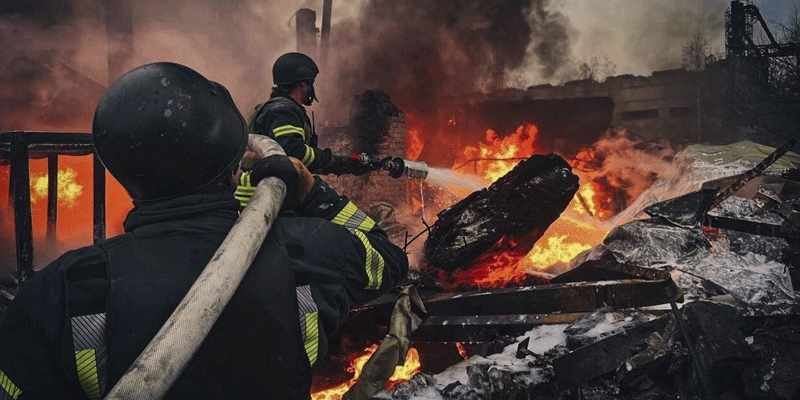

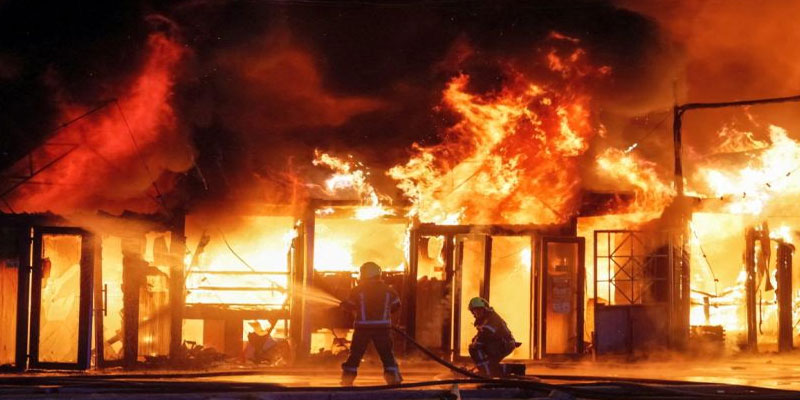
A Russian missile strike on the ArcelorMittal steel complex in Ukraine's Kryvyi Rih has brought the Russia-Ukraine war closer to Indian business interests, killing two workers and injuring at least 13 others. The attack damaged critical infrastructure at the country's largest integrated steel and mining facility, owned by Indian-origin billionaire Lakshmi Mittal's ArcelorMittal, forcing a partial suspension of operations. The strike reflects a widening phase of the conflict in which industrial assets, energy facilities and foreign-owned businesses are increasingly becoming casualties of escalating warfare.
Indian-Owned Industrial Giant Caught in the Crossfire
The attack took place overnight on August 16 at the ArcelorMittal Kryvyi Rih plant in central Ukraine, a cornerstone of the country's metallurgical industry. The facility is not only Ukraine's largest steel and mining complex but also one of ArcelorMittal's most important European production centres.
According to the company, the missile strike severely damaged power-generation units and blast furnace infrastructure, disrupting production and exposing thousands of workers to heightened uncertainty. The incident has become one of the most significant examples of an Indian-owned industrial asset being directly affected by the war.
Heavy Damage and Human Cost
ArcelorMittal confirmed that two employees lost their lives, while at least 13 to 14 workers and contractors sustained injuries during the attack.
Ukrainian President Volodymyr Zelenskyy, whose hometown is Kryvyi Rih, said the broader Russian assault on the city also killed two people and wounded several others, matching the casualty figures reported by the company.
Emergency teams responded quickly, but the destruction of critical industrial infrastructure has raised concerns that restoring full operations could take weeks.
Escalation Follows Massive Cross-Border Attacks
The strike came amid one of the war's most intense exchanges of aerial attacks.
Ukraine reportedly launched hundreds of drones deep into Russian territory, triggering widespread air-defence responses and causing casualties. Russia's Defence Ministry claimed its forces intercepted 822 Ukrainian drones targeting Moscow and other regions, describing it as one of the largest drone offensives of the conflict.
In retaliation, Russia unleashed extensive missile and drone attacks on Ukrainian cities and industrial hubs, including Kryvyi Rih, reinforcing a cycle of escalating strikes that increasingly targets economic infrastructure far from the front lines.
Why the Attack Matters for India
For India, the incident carries significance beyond corporate losses. ArcelorMittal's Ukrainian operations represent a major industrial investment with links to European steel supply chains, employment and regional manufacturing.
The attack highlights several emerging concerns:
· Growing exposure of Indian investments in conflict zones.
· Supply-chain disruptions affecting European steel markets.
· Increased need for contingency planning for overseas assets.
· Greater emphasis on geopolitical risk assessment for Indian companies operating abroad.
The episode also comes as India continues to maintain a carefully balanced diplomatic position on the Russia-Ukraine conflict.
Industry Becomes a Battlefield
The Kryvyi Rih strike reflects a broader trend in which power stations, steel plants, refineries and transport infrastructure are increasingly treated as strategic targets. Such attacks weaken production capacity, disrupt economic activity and place civilian workers directly in harm's way.
A Stark Reminder of War's Expanding Reach
The attack on Lakshmi Mittal's steel plant illustrates how the Russia-Ukraine war is no longer confined to military front lines. As industrial infrastructure becomes central to wartime strategy, foreign-owned businesses face growing operational and financial risks. For India, the incident underscores the importance of protecting overseas investments while navigating an increasingly volatile geopolitical landscape where economic assets can quickly become strategic targets.
(With agency inputs)