
A Major Milestone in India's Indigenous Missile Development
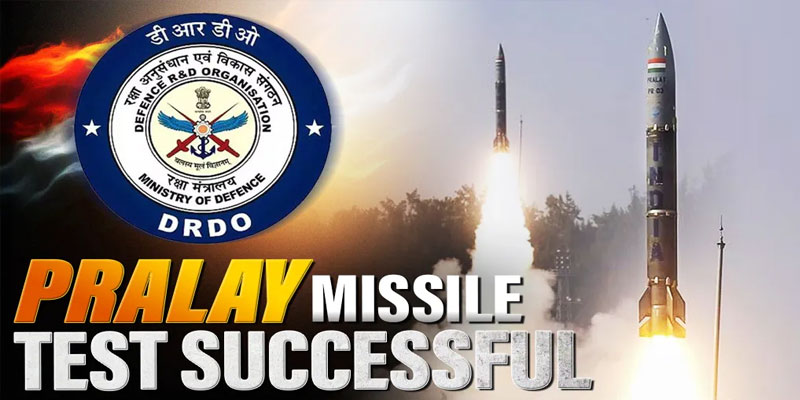
India has successfully conducted a user-evaluation flight test of its indigenously developed Pralay quasi-ballistic missile, capable of striking targets at distances of up to 500 km. Conducted on November 5, 2026, the test marks a significant milestone in India's defence preparedness, bringing the missile closer to operational induction into the armed forces. The successful trial demonstrated that the weapon system met all prescribed mission objectives, reinforcing India's growing capabilities in precision conventional warfare.
Understanding Pralay: Technology and Background
Developed by the Defence Research and Development Organisation (DRDO), Pralay is a surface-to-surface, solid-propellant quasi-ballistic missile designed primarily for conventional battlefield operations. Its development represents India's effort to strengthen indigenous missile technology and reduce dependence on foreign defence systems.
Unlike conventional ballistic missiles, which follow a relatively predictable trajectory, a quasi-ballistic missile can manoeuvre during flight. This makes its movement harder to anticipate and significantly complicates interception by enemy air-defence systems.
Pralay's development began with its first successful flight test in December 2021, validating its trajectory, guidance, control and mission algorithms.
Key technical capabilities include:
· Operational range: Approximately 150–500 km, depending on payload configuration.
· Payload capacity: Around 500–1,000 kg.
· Propulsion: Solid-fuel propulsion for rapid launch readiness.
· Mobility: Compatibility with mobile launch platforms, enabling flexible deployment.
· Warhead: Conventional payload designed for precision battlefield strikes.
What the November 5 Test Demonstrated
The missile was launched at approximately 11:10 a.m. from Dr APJ Abdul Kalam Island off the Odisha coast. The Integrated Test Range at Chandipur monitored its flight using sophisticated range instrumentation.
The Defence Ministry confirmed that all mission objectives were successfully achieved. The trial also demonstrated the missile's ability to follow its designated trajectory, execute mid-course manoeuvres and deliver precision strikes under operational evaluation conditions.
Importantly, a user-evaluation trial goes beyond basic technological validation. It assesses whether a weapon can meet the operational requirements of the armed forces before its acceptance and induction.
Strategic Benefits and Military Implications
Pralay could substantially strengthen India's conventional strike capabilities, particularly along sensitive and contested borders.
Its principal advantages include:
· Deep-strike capability: Targets such as enemy airfields, command centres, radar installations, logistics hubs and hardened military positions can be engaged within its range.
· Improved survivability: Manoeuvrability makes interception more challenging for adversary air-defence networks.
· Rapid deployment: Solid propulsion and mobile launchers support operational flexibility and quicker response.
· Conventional deterrence: It provides commanders with a powerful precision-strike option without resorting to nuclear weapons.
· Indigenous strength: Its development strengthens India's domestic defence manufacturing and technological ecosystem.
The Road Ahead: From Testing to Induction
With user-evaluation objectives achieved, Pralay appears close to operational induction. The remaining stages are expected to involve service acceptance, production scaling, unit integration, personnel training and logistical preparations.
Strengthening India's Conventional Deterrence
Pralay represents more than another addition to India's missile inventory. It fills an important capability gap between conventional artillery and longer-range strategic missile systems. Its combination of mobility, precision, manoeuvrability and indigenous technology could provide India with a decisive battlefield advantage. As regional security challenges evolve, this missile will strengthen India's ability to respond swiftly, deter aggression and protect its strategic interests while reinforcing its ambition to become increasingly self-reliant in defence production.
(With agency inputs)