
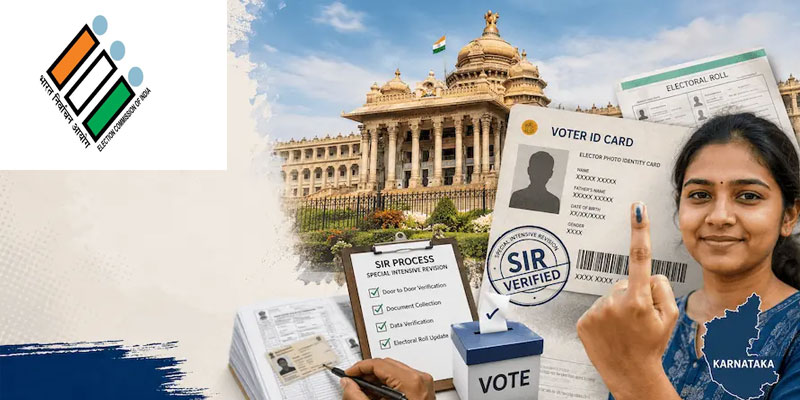
Karnataka’s Special Intensive Revision (SIR) of electoral rolls has triggered a major debate over voter verification, electoral transparency and the risk of disenfranchisement. The final electoral roll, published on October 27, 2026, contains 4.55 crore voters, nearly 99.32 lakh fewer than the 5.54 crore registered before the exercise. While the Election Commission’s objective is to improve electoral accuracy, the scale of the reduction has raised questions about whether every eligible voter has been protected.
What the Final Electoral Roll Reveals
The revision initially produced a substantial reduction in the electorate. The draft roll published on August 24 listed 4.46 crore voters after 1.08 crore names were excluded, representing 19.48% of the original electorate.
During the subsequent claims-and-objections process, 8.64 lakh voters were added, bringing the final tally to 4.55 crore. The difference between the original and final lists is approximately 99.32 lakh voters.
The principal categories of exclusions were:
· 80.62 lakh: Voters reported as permanently shifted or untraceable.
· 16.39 lakh: Voters recorded as deceased.
· 7.10 lakh: Duplicate entries.
· 3.84 lakh: Other reasons.
These figures indicate that migration and difficulties in locating voters accounted for the largest share of removals.
Why Were So Many Names Removed?
The SIR requires electors to submit enumeration forms to establish their continued eligibility. Names may be excluded when individuals have died, permanently relocated, appear multiple times or cannot be verified during the exercise.
Karnataka’s urbanisation and internal migration may partly explain the large number of voters classified as shifted or untraceable. Frequent address changes, rented accommodation and difficulties contacting residents can complicate verification.
However, being absent during verification does not necessarily mean a person is ineligible to vote. The accuracy of individual deletions, the quality of field verification and the opportunity to appeal are therefore critical to assessing the exercise.
Political Controversy and Allegations
The revision has become a political flashpoint. The Congress has alleged that the deletions could disproportionately affect minorities, economically disadvantaged voters and marginalised communities. It has also raised concerns about Form 7 applications seeking deletions, including allegations that some were submitted through third parties or without adequate verification.
The Congress has questioned whether affected voters received sufficient notice and a fair opportunity to restore their names. The BJP and the Election Commission, meanwhile, maintain that electoral-roll revision is necessary to remove ineligible entries and improve accuracy.
These allegations require verification; the overall reduction alone does not establish deliberate voter suppression. Equally, administrative claims of accuracy cannot substitute for transparent evidence that eligible voters were not wrongly excluded.
What Are the Possible Consequences?
The immediate consequence is a smaller electorate, but the implications extend beyond the headline figure.
· Eligible voters omitted from the final roll may be unable to vote unless their names are restored through the applicable procedures.
· Political parties may intensify voter-verification campaigns and challenge disputed deletions.
· Scrutiny of Booth Level Officers, deletion applications and the claims-and-objections process is likely to increase.
· The controversy could influence public confidence in election administration and the fairness of future contests.
Constituency-wise deletion data and information about successful appeals will be particularly important in determining whether the impact has been uneven.
Electoral Accuracy Must Never Come at Democracy’s Expense
Karnataka’s SIR presents a crucial test of how India balances clean electoral rolls with every eligible citizen’s right to vote. Removing duplicate and deceased entries can strengthen democracy, but wrongful exclusions can undermine its legitimacy. The priority now must be transparent, independently verifiable data, accessible correction procedures and effective remedies for affected electors. Ultimately, the success of the revision should not be measured simply by how many names disappear, but by whether every eligible voter retains a fair opportunity to participate in the democratic process.
(With agency inputs)