
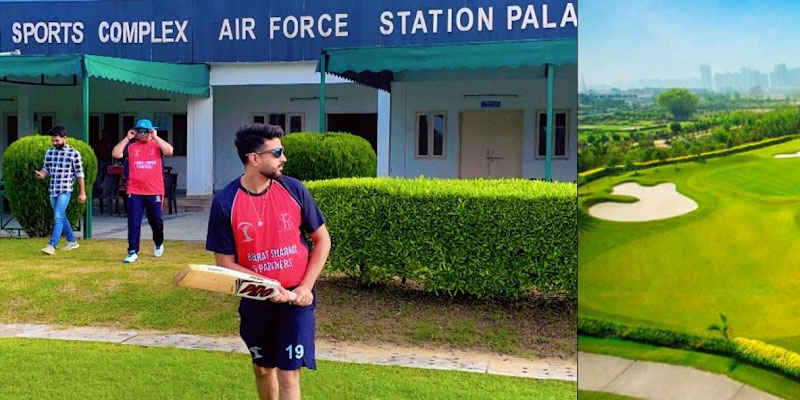
Air Force Sports Complex Shut: Why was it closed? The sudden shutdown of the Air Force Sports Complex and Golf Course on Lok Kalyan Marg in central Delhi has raised questions about the future of a prominent recreational facility near the Prime Minister’s official residence. Closed until further notice, the complex’s shutdown has disrupted sporting activities, affected workers and forced the cancellation of a customary farewell event for outgoing Air Chief Marshal A.P. Singh.
What Happened and Why Is It Significant?
The facility, which includes an 18-hole golf course, swimming pool, restaurants and other recreational amenities, was closed to members from Wednesday. Reports indicate that staff, maintenance personnel, domestic workers and contractual employees were also told not to report for duty, leaving hundreds uncertain about their employment and income.
The closure disrupted the traditional “golfing-out” farewell for Air Chief Marshal Singh, who is due to retire on October 31. The ceremony is a customary send-off for a departing Chief of the Air Staff, giving the shutdown significance beyond the loss of access to a sports facility.
The Land Dispute Behind the Closure
The immediate trigger appears to be notices issued by the Land and Development Office (L&DO), under the Union Ministry of Housing and Urban Affairs, seeking the return of land on Lok Kalyan Marg. Reports suggest that the ministry has informed the Indian Air Force (IAF) that the government requires land allotted to the force decades ago.
The latest action suggests renewed efforts to reclaim disputed parcels. However, the precise legal status of the complex and the government’s final plans require official clarification.
Why Lok Kalyan Marg Matters
Lok Kalyan Marg is a strategically sensitive government precinct housing the Prime Minister’s official residence and other high-security establishments. Decisions involving land here intersect with defence estate management, public land administration and security planning.
A broader effort to reclaim government land held by defence establishments and colonial-era clubs could reshape access to valuable properties in Lutyens’ Delhi.
Is Eviction or Demolition Next?
Neither permanent eviction nor demolition can be treated as confirmed at this stage. The closure could be an interim administrative measure while the government and the IAF address the land issue.
Key questions remain:
· Will the IAF challenge the notices based on historical allotment and lease conditions?
· Will the land be transferred to another government agency or assigned a different public purpose?
· What arrangements, if any, will protect affected employees and existing users?
Law, Clarity and Fairness
The immediate shutdown has disrupted military welfare facilities and livelihoods, while raising broader questions about government land management. The IAF may contest the action through legal or administrative channels, depending on the allotment terms and applicable law.
Ultimately, the government must clarify whether this is a temporary closure or the first step towards permanent repossession. Any final decision should rest on legal authority, transparent procedures and fair consideration of affected personnel and workers. Until that clarity emerges, eviction and demolition remain possibilities to be assessed—not established outcomes.
(With agency inputs)