
A Massive Push to Make AI Part of Everyday Classrooms
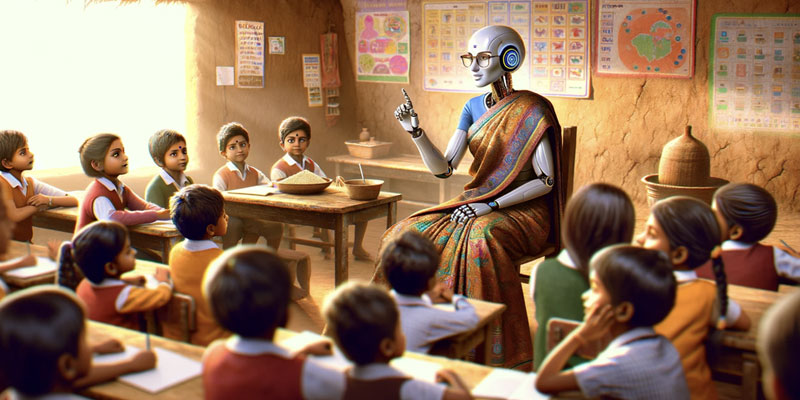
India has launched what is being described as the world’s largest AI literacy programme in education, aiming to train one million teachers in artificial intelligence by 2027. The initiative, led by Bodhan AI and supported by the Ministry of Education, seeks to transform AI from a specialised technology topic into a daily classroom assistant accessible across schools nationwide.
At the heart of the programme is an ambitious vision: building a national education-focused AI ecosystem that reaches not only elite urban institutions but also government schools and rural classrooms with limited resources. Officials describe the effort as a foundational step toward preparing India’s future workforce for an AI-driven economy.
What the Programme Intends to Achieve
The initiative is structured as a multi-year teacher training mission spanning CBSE schools, state boards and public education systems. Rather than treating AI as a standalone subject, the programme aims to integrate AI directly into teaching workflows.
Teachers will receive AI literacy modules designed to explain core AI concepts, ethical considerations and practical classroom applications. These modules are expected to align with National Council of Educational Research and Training guidelines and state education frameworks.
The programme also promotes AI-powered teaching assistance. Tools under development can automatically generate quizzes, worksheets, simulations and multilingual learning material tailored to different grades and subjects. The broader goal is to reduce teacher workload while improving personalised learning support for students.
The Role of Bodhan AI and IIT Madras
Bodhan AI has been established as a national Centre of Excellence for AI in Education at Indian Institute of Technology Madras. The project aims to create what developers call a “Bharat EduAI Stack” — a public digital infrastructure framework for education-focused AI applications.
The concept is inspired by India’s successful digital public infrastructure models such as India Stack in fintech. Through open APIs and interoperable systems, states, schools and edtech companies would be able to build AI tools compatible with a shared national architecture.
Another key focus is AI sovereignty. Officials emphasise that educational AI models should remain India-hosted, multilingual and context-sensitive, with safeguards to protect children’s data and ensure responsible AI usage.
Why Training One Million Teachers Matters
The scale of the initiative reflects the growing recognition that AI readiness depends not only on engineers and technology firms but also on school systems. Government and industry estimates suggest India could require more than 1.25 million AI professionals by 2027. Yet most school teachers currently have limited exposure to AI tools or digital pedagogy.
Analytically, the programme attempts to address three major concerns simultaneously. First is educational equity. By targeting government schools and regional-language classrooms, the initiative seeks to prevent AI from deepening existing educational divides.
Second is the shift from “AI as curriculum” to “AI as infrastructure.” Instead of merely teaching students about AI, the programme aims to embed AI into lesson planning, assessment and remedial support systems.
Third is teacher empowerment. The initiative positions AI as an assistant rather than a replacement, aiming to build trust among educators rather than fear of technological displacement.
Challenges That Could Shape Success
Despite its scale and ambition, the programme faces significant implementation challenges. Many public schools still lack reliable internet access, digital devices and basic technological infrastructure. AI-driven educational tools will struggle to function effectively unless these foundational gaps are addressed simultaneously.
There are also concerns about superficial training. Reaching one million teachers numerically may prove easier than ensuring deep and sustained AI competence. Long-term mentoring and practical classroom integration will likely determine the programme’s real impact.
Data governance remains another critical issue. As AI systems collect detailed information about student learning patterns and behaviour, maintaining privacy, transparency and accountability will become essential.
A Defining Experiment in AI-Powered Education
India’s AI literacy mission represents one of the most ambitious attempts globally to integrate artificial intelligence into public education at scale. If implemented effectively, it could redefine how teachers teach, how students learn and how educational technology is deployed across diverse socio-economic settings.
More importantly, the initiative signals a broader shift in India’s education strategy — from viewing AI merely as a future industry to treating it as a foundational public capability. Success will depend not only on technology, but on whether the country can build an inclusive, ethical and teacher-centred AI ecosystem that genuinely enhances learning outcomes across the classroom spectrum.
(With agency inputs)