
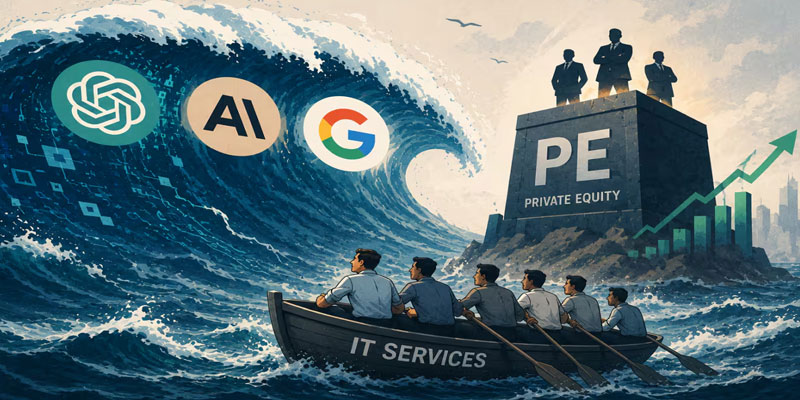
The global artificial intelligence race is entering a decisive new phase as major AI companies shift aggressively from consumer-facing tools to enterprise integration. OpenAI, Anthropic and Google are now embedding AI systems directly into business operations through strategic partnerships with private equity giants such as Blackstone and Goldman Sachs. What initially began as a race to dominate consumer chatbots is rapidly evolving into a much larger battle for enterprise workflows — one that could fundamentally disrupt the traditional IT outsourcing model that has powered companies like Infosys, Tata Consultancy Services and Wipro for decades.
AI Firms Move Deep into Enterprise Operations
The latest push reflects a strategic shift toward “hardwiring” AI into core business systems. Anthropic’s reported $1.5 billion enterprise initiative aims to integrate its Claude AI models directly into the operational frameworks of private equity portfolio companies. This creates a powerful distribution channel that bypasses traditional consulting and outsourcing intermediaries.
At the same time, OpenAI is increasingly deploying engineers and consultants to help enterprises customize ChatGPT-based systems for internal workflows, while Google’s Gemini Enterprise platform is positioning itself as a unified AI infrastructure for cloud-based automation across finance, healthcare and manufacturing sectors.
Unlike earlier automation software, these generative AI systems are capable of performing higher-order cognitive tasks such as coding, data analysis, customer support, documentation and workflow management — tasks that traditionally generated large outsourcing contracts billed on manpower and hourly deployment.
Why Traditional IT Services Face a Structural Threat
For years, India’s IT outsourcing sector thrived on labour arbitrage: offering large-scale human resources for repetitive technology and business process tasks at lower costs. However, enterprise AI is beginning to challenge the very foundation of that model.
Analysts estimate that generative AI can automate 30 to 40 percent of routine IT services work, including testing, support operations, business process outsourcing and basic software maintenance. As private equity-backed firms rapidly adopt embedded AI systems, clients are increasingly prioritising automation efficiency over workforce-heavy contracts.
This transition threatens margins for traditional IT giants, especially in commoditised services where differentiation is limited. Instead of paying for thousands of support personnel, companies may increasingly prefer AI-native platforms that deliver faster and cheaper outcomes.
The Rise of AI Governance and “Agentic Enterprise”
Yet the transformation is not entirely destructive for the IT sector. As enterprises deploy AI more deeply, entirely new service categories are emerging around governance, compliance, orchestration and security.
Experts describe this shift as the rise of the “agentic enterprise,” where AI agents autonomously execute tasks but still require human oversight, ethical safeguards and regulatory monitoring. This creates growing demand for AI integration specialists, cybersecurity experts, risk auditors and compliance consultants.
Companies such as Accenture are already repositioning themselves around AI ethics, multi-agent systems and governance frameworks rather than conventional coding-heavy outsourcing.
A Defining Turning Point for Global IT Services
The enterprise AI revolution represents a profound restructuring of the technology services industry rather than a temporary disruption. AI giants are no longer merely software providers; they are becoming core infrastructure partners embedded inside corporate operations. For traditional outsourcing firms, survival will depend on how quickly they transition from labour-driven execution models to high-value AI governance, integration and strategic consulting. The era of large-scale commoditised IT services is beginning to fade, and the next phase of the industry will likely belong to companies capable of combining AI automation with human judgment, trust and regulatory expertise.
(With agency inputs)