
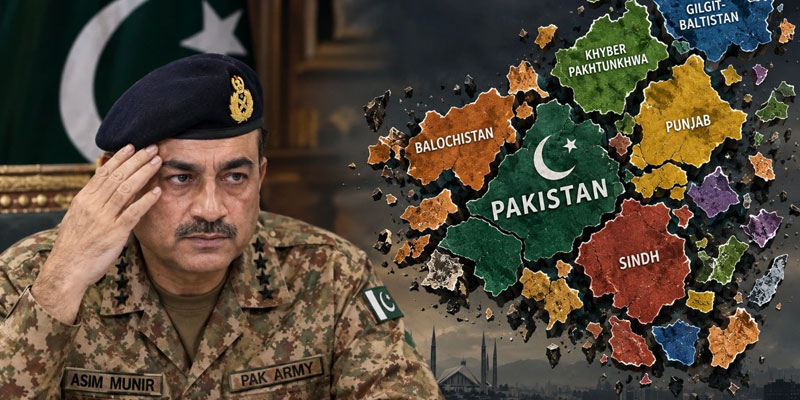
Pakistan’s reported proposal to divide its four provinces into 12–15 smaller units has triggered a debate over governance, federalism and the military’s influence on civilian politics. Field Marshal Asim Munir is reportedly backing the idea, which could fundamentally alter the country’s administrative structure. While supporters point to improved public-service delivery, critics suspect that restructuring could weaken established political power centres and increase ccontrol over provincial affairs.
Why Pakistan’s Provincial Map Matters
Since independence in 1947, Pakistan has comprised four provinces: Punjab, Sindh, Khyber Pakhtunkhwa (KP) and Balochistan. Their vastly different populations, geographical sizes and political identities have long complicated governance.
Punjab, with a population exceeding 120 million, accounts for more than half the country’s population. Balochistan, meanwhile, is Pakistan’s largest province by area but has a comparatively small population.
Planning Minister Ahsan Iqbal has previously called for a national debate on administrative restructuring. However, no final provincial map or officially confirmed decision has been announced, and reports about Munir’s backing should be treated as unconfirmed.
Inside the Reported Plan: Two Possible Models
Reports describe two potential approaches to restructuring Pakistan’s administration:
· Creating 12–15 provinces: Dividing the existing four provinces into smaller administrative and political units.
· Empowering approximately 160 district governments: Decentralising authority without necessarily creating additional provinces.
Possible divisions reportedly include North, Central and South Punjab; multiple regions within Sindh; Northern, Southern and Tribal KP; and East, West and South Balochistan.
Advocates argue that smaller units could bring government services closer to citizens, improve administrative responsiveness and address regional inequalities. However, the precise boundaries, governance arrangements and distribution of resources remain unsettled.
The Political Calculation: Weakening Established Power Centres?
Pakistan’s provinces are not merely administrative territories; they underpin political parties, electoral constituencies and regional identities.
· Punjab: Traditionally a major stronghold of the Pakistan Muslim League-Nawaz (PML-N), the province commands considerable electoral influence.
· Sindh: The Pakistan People’s Party (PPP) has maintained a powerful political base, making any proposed division particularly sensitive.
· Military influence: Critics fear that smaller provinces could become more dependent on the federal government, potentially strengthening the military establishment’s influence over civilian institutions.
The central controversy is whether restructuring would genuinely decentralise governance or fragment existing political power bases. These concerns remain interpretations of the reported proposal, rather than proof of a military strategy.
Constitutional and Ethnic Obstacles
Pakistan’s Constitution presents a significant hurdle. Under Article 239(4), an amendment changing provincial boundaries requires approval by the concerned provincial assembly with a two-thirds majority before presidential assent.
Any attempt to divide Sindh or Balochistan could also provoke resistance over ethnic identity, resource distribution and historical grievances. Karachi’s position as Pakistan’s commercial hub makes changes affecting Sindh especially contentious.
Administrative Reform or Military Power Consolidation?
Munir’s reported plan remains uncertain, but its potential consequences extend far beyond bureaucratic restructuring. Smaller provinces and empowered districts could improve governance if accompanied by genuine local autonomy, adequate resources and democratic accountability.
Conversely, restructuring imposed without broad political consensus could deepen regional mistrust and weaken federalism.
The defining question is who ultimately gains power from redrawing Pakistan’s map: its citizens and elected representatives, or the institutions already exercising substantial influence over the state. Until the proposal is formally presented and constitutionally debated, both its administrative merits and its political implications remain open to scrutiny.
(With agency inputs)