

From Google to IBM: Indian-Origin CEOs Lead Corporate America
As the United States approaches the milestone of its 250th anniversary, the growing influence of Indian-origin leaders at the helm of some of the world's largest corporations has become a defining story of modern American business. From technology and software to consumer goods, executives such as Sundar Pichai, Satya Nadella, Indra Nooyi, Shantanu Narayen, and Arvind Krishna have risen to lead globally recognised companies. Their journeys not only reflect remarkable personal achievements but also underscore the enduring role of immigration in driving innovation, economic growth, and corporate transformation across the United States.
Immigration and America's Innovation Story
For decades, the United States has attracted highly skilled professionals and students from around the world, particularly in science, technology, engineering, and management. Indian professionals have been among the largest contributors to this talent pool, with many pursuing higher education, research, and careers that have significantly influenced America's technology and business landscape.
Over time, Indian-origin executives have progressed from technical and managerial roles to the highest levels of corporate leadership. Their rise reflects not only individual excellence but also the opportunities created by an ecosystem that rewards innovation, entrepreneurship, and global perspectives.
Their success demonstrates how skilled immigration has become an important pillar of America's economic competitiveness, helping companies adapt to technological disruption, global competition, and changing consumer expectations.
Five Leaders Who Redefined Global Business
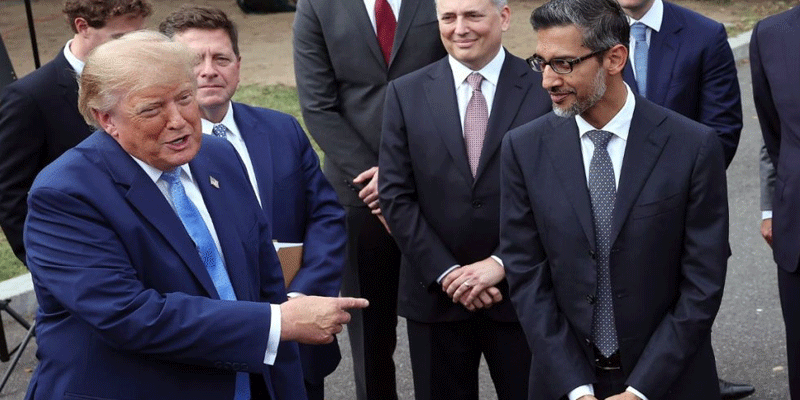
Sundar Pichai, who rose from Chennai to become the chief executive of Alphabet and Google, has overseen the company's expansion into artificial intelligence, cloud computing, and next-generation digital platforms. His leadership has positioned Google at the forefront of the AI revolution while strengthening its global technology ecosystem.
Satya Nadella transformed Microsoft after assuming leadership in 2014. By prioritising cloud computing, enterprise software, and artificial intelligence, he engineered one of the most remarkable corporate revivals in the technology industry. His emphasis on organisational culture and continuous innovation has become a benchmark for modern corporate leadership.
Indra Nooyi, during her tenure at PepsiCo, reshaped the company's long-term strategy by diversifying its product portfolio and increasing investments in healthier food and beverage offerings. Her leadership demonstrated that transformational management extends well beyond the technology sector.
Shantanu Narayen successfully guided Adobe's transition from traditional software licensing to subscription-based cloud services, fundamentally changing the company's revenue model and substantially increasing its market value.
Arvind Krishna, Chairman and CEO of IBM, has accelerated the company's focus on hybrid cloud computing and artificial intelligence. His leadership has also been associated with IBM's landmark acquisition of Red Hat, one of the largest software acquisitions in industry history.
Why Their Leadership Matters
Collectively, these executives illustrate how cross-border talent strengthens American corporations by combining technical expertise with global business perspectives. Their leadership has influenced innovation, digital transformation, employment generation, and shareholder value across industries.
Their success also reinforces the close economic relationship between India and the United States, highlighting how the movement of skilled professionals contributes to productivity, technological advancement, and knowledge exchange that benefits both nations.
A Shared Legacy of Innovation
As America prepares to celebrate 250 years of nationhood, the prominence of Indian-origin CEOs reflects a broader narrative about opportunity, diversity, and innovation. Their achievements demonstrate that immigration has contributed not only to the American workforce but also to its leadership ranks. By steering some of the world's most influential companies through periods of rapid technological and economic change, these executives exemplify how global talent continues to shape the future of corporate America while strengthening the enduring partnership between India and the United States.
(With agency inputs)