
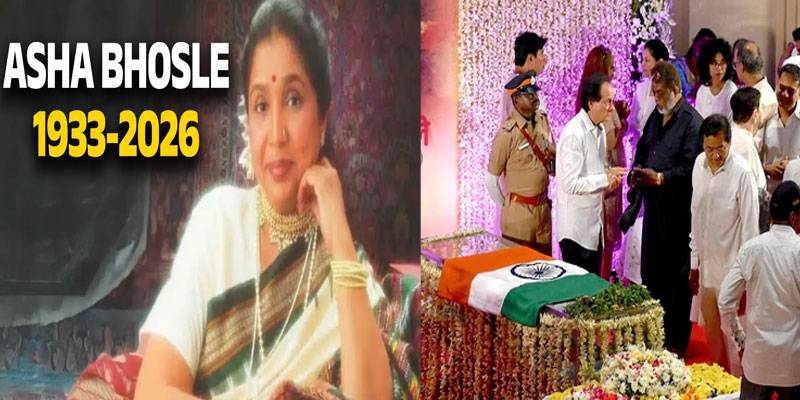
Legendary singer Asha Bhosle passed away at the age of 92 in Mumbai on April 12 due to multi-organ failure. Her death marks the loss of one of India’s most versatile and enduring musical voices. Her last rites are scheduled for April 13 in Mumbai, where a stream of celebrities, political leaders, and admirers have gathered at her residence to pay their final respects, reflecting the immense cultural imprint she leaves behind.
Final Journey and National Tribute
Asha Bhosle breathed her last at Breach Candy Hospital after battling respiratory complications that led to multiple organ failure. Her mortal remains were brought to her residence in Lower Parel for public viewing, allowing fans and well-wishers to bid farewell.
The funeral procession will move to Shivaji Park, where she will be cremated with full state honours—an acknowledgment of her extraordinary contribution to Indian culture. Among those who visited her residence were Shah Rukh Khan, Tabu, Anuradha Paudwal and Sachin Tendulkar, underscoring her cross-generational influence.
Early Life: From Struggle to Stardom
Born in 1933 in Sangli, Maharashtra, Asha Bhosle was the daughter of noted classical vocalist Deenanath Mangeshkar. Her early years in the film industry were far from easy. Overshadowed by her elder sister, Lata Mangeshkar, she was often relegated to singing for secondary characters and low-budget productions.
However, her resilience and willingness to experiment gradually set her apart. She refused to be confined to conventional roles and instead embraced diverse musical styles, laying the foundation for a career that would span over eight decades.
A Career Defined by Versatility
Asha Bhosle’s musical journey is unmatched in its breadth and adaptability. She collaborated with iconic composers such as R. D. Burman and O. P. Nayyar, producing some of Bollywood’s most memorable songs.
Her repertoire ranged from peppy cabaret numbers like “Piya Tu Ab to Aaja” and “Yeh Mera Dil” to soulful melodies and ghazals. Songs such as “Dum Maro Dum” and “Parde Mein Rehne Do” showcased her flair for bold, contemporary styles, while “Dil Cheez Kya Hai” from Umrao Jaan and “Mera Kuch Samaan” from Ijaazat highlighted her mastery over nuanced, poetic compositions.
She recorded thousands of songs across multiple Indian languages and genres, earning Filmfare Awards, National Awards, and even international recognition, including Grammy nominations.
Reinvention and Global Appeal
Unlike many of her contemporaries, Asha Bhosle continuously reinvented herself. In the 1990s and 2000s, she embraced Indipop, remixes, and global collaborations, earning the title “Queen of Indipop.” Her openness to experimentation allowed her to remain relevant across generations, bridging traditional Indian music with modern global influences.
Legacy: A Voice That Defined Generations
Asha Bhosle’s journey from being known as Lata Mangeshkar’s younger sister to becoming a cultural icon in her own right is a testament to her individuality and artistic courage. Her voice gave life to a wide spectrum of female characters—from playful and rebellious to deeply emotional and introspective.
Her passing has been widely described as “the end of an era,” yet her music continues to resonate across time, genres, and audiences.
Immortality Through Music
While Asha Bhosle’s physical presence is gone, her legacy remains immortal through her vast body of work. Her songs, rich in emotion and diversity, will continue to inspire artists and listeners alike. In celebrating her life, India not only mourns a legendary singer but also honours a voice that defined the very soul of its musical heritage.
(With agency inputs)