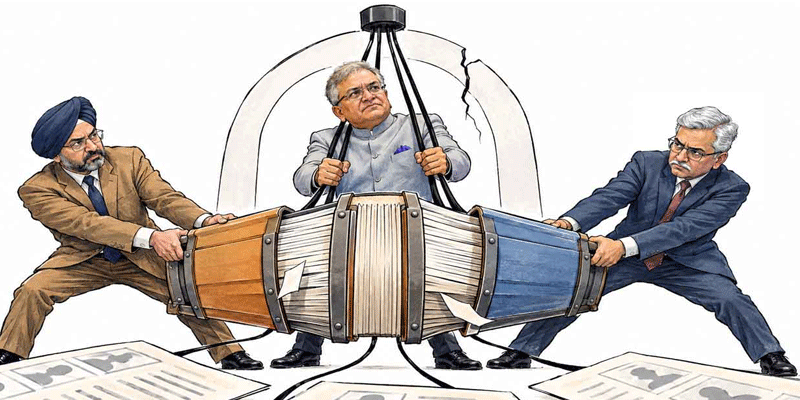


The Central Board of Secondary Education is facing mounting criticism after technical glitches in its newly introduced On-Screen Marking (OSM) system disrupted the Class 12 re-evaluation process. Following widespread complaints from students and parents, Union Education Minister Dharmendra Pradhan has directed CBSE to submit a detailed report and involved expert teams from Indian Institute of Technology Madras and Indian Institute of Technology Kanpur to stabilize the system.
The OSM platform was launched this year to digitally evaluate nearly 98 lakh answer sheets, replacing the traditional manual process. However, the rollout quickly turned chaotic. Students reported portal crashes, failed payment confirmations, blurred scans, missing supplementary pages, and even mismatched answer sheets uploaded under incorrect student profiles. Several candidates alleged that Physics and other subject papers displayed on the portal did not belong to them, raising serious concerns over data integrity and tagging accuracy.
Teachers had reportedly warned CBSE months earlier about insufficient evaluator training, weak scan quality, and operational risks. Despite these alerts, over 68,000 answer books later required rescanning, while more than 13,500 had to undergo manual verification. The Class 12 pass percentage also fell to 85.20%, triggering a surge in re-evaluation requests that further strained the already unstable system.
The controversy has now taken a political turn. Congress leader Jairam Ramesh criticised the government for failing to anticipate the crisis before implementation and questioned the preparedness of the digital rollout. The opposition accused authorities of reacting only after public outrage intensified.
Beyond the immediate disruptions, the incident exposes deeper structural weaknesses in India’s education technology ecosystem. Experts believe the rushed deployment lacked adequate stress testing, cybersecurity preparedness, server scalability, and fallback mechanisms. While digitisation is intended to improve transparency and efficiency, poor execution has instead created anxiety among students whose academic futures depend on reliable systems. The crisis serves as a strong reminder that India’s digital public infrastructure must prioritize resilience, accountability, and security-by-design before large-scale national deployment.