
A Strategic Shift in India’s Airpower Vision
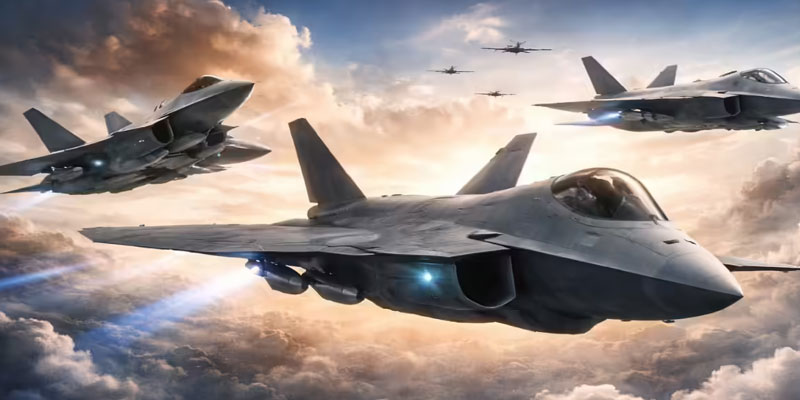
India is exploring the possibility of joining one of two European-led sixth-generation fighter jet programmes, marking a significant shift in its defence strategy. A parliamentary panel has confirmed that New Delhi is evaluating participation in either the Future Combat Air System (FCAS) or the Global Combat Air Programme. This move comes even as India advances its indigenous fifth-generation fighter project, the Advanced Medium Combat Aircraft (AMCA), highlighting a dual-track approach to future-proof its air capabilities amid evolving global threats.
India’s Options: FCAS vs GCAP
The FCAS programme, led by France, Germany, and Spain, is designed as a “system of systems.” It integrates a next-generation manned fighter with a network of drones, sensors, and advanced data-sharing platforms, all powered by artificial intelligence. The focus is on creating a highly connected combat ecosystem rather than just a standalone aircraft.
On the other hand, GCAP—led by the UK, Italy, and Japan—prioritises faster deployment, aiming for operational readiness by the mid-2030s. It also places strong emphasis on export potential and collaborative development. India has held preliminary discussions with France regarding FCAS and has shown interest in meaningful co-development rather than a limited manufacturing role. Meanwhile, GCAP partners have indicated openness to new members, keeping India’s options flexible.
Indigenous Push: AMCA and Engine Development
India’s indigenous AMCA programme remains central to its long-term strategy. The Indian Air Force plans to induct six squadrons starting around 2035, providing a fifth-generation baseline with stealth, advanced avionics, and internal weapon systems. This platform is expected to serve as a foundation for future sixth-generation capabilities.
A critical component of this effort is engine development. India has partnered with Safran to co-develop a high-thrust engine, with a focus on deep technology transfer in design and manufacturing. This collaboration aims to reduce dependence on foreign propulsion systems—one of the most sensitive areas in defence technology.
How Sixth-Generation Fighters Will Transform Warfare
Sixth-generation fighter programmes are expected to redefine air combat in multiple ways. One key feature is manned-unmanned teaming, where a piloted aircraft controls swarms of drones for surveillance, jamming, and strike missions. This increases combat effectiveness while reducing risks to pilots.
Artificial intelligence will play a major role, enabling real-time data fusion, target prioritisation, and faster decision-making. Advanced stealth technologies will enhance survivability in contested environments, while electronic warfare capabilities will dominate the electromagnetic spectrum. Additionally, combat cloud networking will connect aircraft with satellites, ground systems, and other assets, transforming fighters into nodes within a larger, integrated battle network.
Strategic and Industrial Implications
For India, participation in a sixth-generation programme offers access to cutting-edge technologies that would otherwise take decades to develop independently. It could also strengthen its position against emerging threats from regional adversaries. However, the challenge lies in ensuring that such collaboration does not reduce Indian industry to a secondary role.
Balancing international partnerships with domestic innovation is crucial. A well-structured collaboration could accelerate technological advancement and boost India’s defence manufacturing ecosystem. Conversely, poor alignment could lead to duplication of efforts and continued dependence on foreign systems.
Choosing the Right Flight Path
India’s exploration of sixth-generation fighter programmes reflects both ambition and necessity. As global air combat evolves rapidly, staying ahead requires a blend of indigenous capability and strategic collaboration. The key lies in crafting a clear roadmap that integrates AMCA with any international partnership while safeguarding domestic interests. If executed effectively, India could emerge not just as a participant but as a significant player in the next era of aerial warfare.
(With agency inputs)