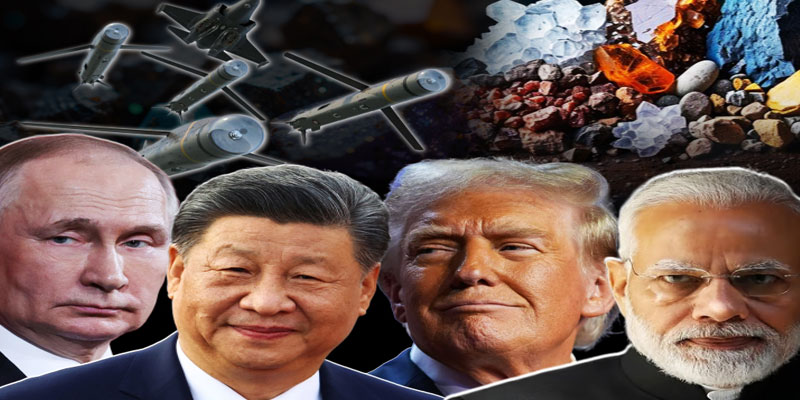
Global rare earth production is fast emerging as the foundation of geopolitical strength and defense supremacy, with nations around the world racing to secure access to these vital minerals. Often called the “strategic oil” of the 21st century, rare earth elements are indispensable to technologies powering defense, renewable energy, and artificial intelligence — from precision-guided missiles and fighter jets to electric vehicles and quantum processors. As supply chains grow more fragile amid rising geopolitical tensions, control over rare earths has become synonymous with national power, industrial resilience, and technological sovereignty.
China remains the undisputed leader in global rare earths production and reserves. In 2024, it produced about 270,000 metric tons, representing nearly 70% of global refined output. More critically, China controls over 90% of the world’s processing and refining capacity, giving it unmatched leverage over high-tech industries and defense supply chains worldwide. Despite tightening environmental regulations and imposing production quotas, Beijing’s vertically integrated ecosystem—from mining to advanced magnet manufacturing—continues to secure its dominance across strategic sectors such as defense, EVs, renewable energy, and AI semiconductors.
This dominance extends beyond economics. China’s grip over midstream and downstream processing effectively gives it geopolitical leverage — making it the de facto gatekeeper of advanced military technologies. Rare earth-derived components are critical in stealth aircraft, radar systems, precision munitions, and naval propulsion, all of which rely on high-performance magnetic materials refined primarily in China.
The United States, while the world’s second-largest producer, remains far behind, producing about 15,000 metric tons annually with an estimated 45,000 metric tons in reserves. Recognizing the strategic vulnerability, Washington is rapidly investing in domestic mining, refining, and recycling infrastructure. Federal agencies such as the Department of Defense and the Department of Energy are channeling funding toward projects in California, Texas, and Alaska, while fostering innovation in alternative refining technologies.
Collaborations with allies — particularly Australia, Vietnam, and Canada — are central to the U.S. strategy of building a “friend-shoring” network, ensuring secure supply chains free from Chinese influence.
Other countries, including Australia, Vietnam, Nigeria, and Thailand, are scaling production to strengthen their roles in the rare earth ecosystem. Australia alone produced 13,000 metric tons in 2024 and continues to expand capacity through government-backed defense partnerships.
With demand expected to rise at over 6% CAGR through 2030, driven by defense modernization, AI growth, and green energy initiatives, nations capable of building integrated mining-to-manufacturing ecosystems will dominate the next era of global competition.
By 2026, rare earth control will redefine defense hierarchies and industrial power, setting the stage for a new world order where mineral autonomy determines technological leadership, security strength, and strategic influence.