
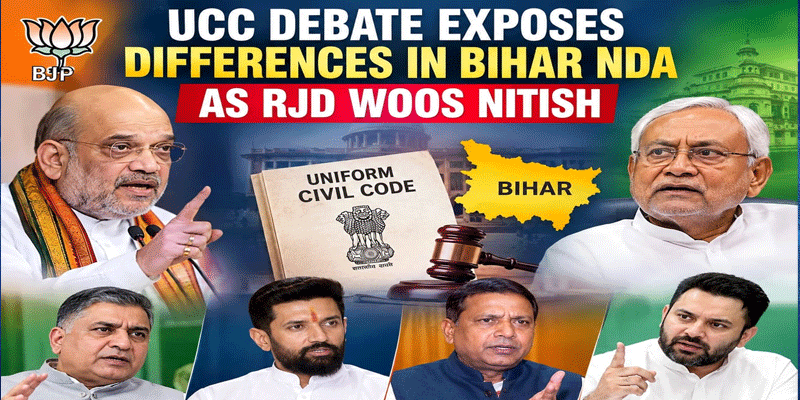
Former Bihar Chief Minister and JD(U) president Nitish Kumar has called a meeting of the party’s MPs, MLAs and MLCs in Patna on September 18, placing the Uniform Civil Code (UCC) at the centre of an important internal discussion. The meeting follows renewed debate after Union Home Minister Amit Shah said the UCC would be implemented in all 21 BJP-led NDA-ruled states before 2029.
UCC Debate Puts JD(U) Under Pressure
The immediate issue is the divergence in statements from JD(U) leaders. Senior leader Shyam Rajak reiterated that the party does not support implementing the UCC in Bihar, pointing to Nitish Kumar’s earlier position. At the same time, Deputy Chief Minister Vijay Kumar Chaudhary adopted a more conditional approach, saying the party would examine the proposed legislation carefully before deciding its position.
Chaudhary said the party would not oppose the measure without examining its provisions and would communicate any concerns after internal consultations. This has left the JD(U) publicly cautious rather than committed to either immediate support or outright opposition.
The September 18 meeting is therefore expected to provide a forum for party representatives to discuss:
· The provisions of the proposed UCC legislation.
· Its implications for Bihar’s communities and customary practices.
· The party’s position within the NDA.
· The need for wider consultation before implementation.
Amit Shah Sets A 2029 Target
The latest political trigger came on September 13, when Amit Shah said he was confident that the UCC would be implemented in all 21 BJP-led NDA states before the 2029 Lok Sabha election. The UCC broadly seeks common rules governing areas such as marriage, divorce, inheritance and adoption, irrespective of religion.
The BJP has pursued the issue through individual states rather than a single nationwide law. Uttarakhand became the first state to bring a comprehensive UCC into force in January 2025, while Gujarat, Assam and Madhya Pradesh have subsequently passed UCC-related legislation, with their laws differing in scope and implementation status.
Bihar Faces a Distinct Constitutional Debate
For Bihar, the question involves both legal provisions and social diversity. Article 44 of the Constitution directs the State to endeavour to secure a Uniform Civil Code, but it forms part of the Directive Principles and is not directly enforceable by courts.
The 21st Law Commission’s 2018 consultation had concluded that a UCC was “neither necessary nor desirable at this stage”, while the 22nd Law Commission reopened consultations in 2023. The debate has consequently involved competing arguments around uniformity, equality, religious practices, customary law and federal legislative authority.
September 18 Meeting Could Define JD(U)’s Position
The JD(U) meeting is significant because it could help reconcile differing voices within the party and establish a clearer position before any decision on Bihar’s implementation.
For the NDA, the episode also illustrates the complexity of translating a common political objective into state-level legislation across jurisdictions with different social and legal circumstances. For JD(U), the immediate task is to examine the proposed law and determine how its provisions align with the party’s stated emphasis on consultation and Bihar’s specific social context.
The September 18 deliberations could therefore become an important step in determining how Bihar responds to the expanding national UCC debate—through a position shaped by the legislation’s actual provisions, consultations and the constitutional framework governing personal laws.
(With agency inputs)