
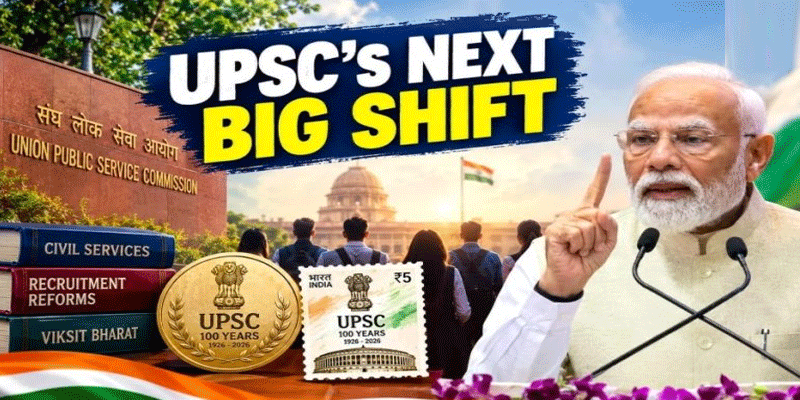
India's Union Public Service Commission (UPSC) marked a historic milestone on October 1, 2026, completing 100 years of public service recruitment. Addressing its centenary celebrations in New Delhi, Prime Minister Narendra Modi called for a renewed administrative vision built around the principles of ‘Nation First, Citizen First’, emphasising that civil servants must combine professional competence with integrity, accountability and a commitment to public welfare.
A Century of Merit-Based Public Recruitment
The origins of the UPSC date back to October 1, 1926, when India's first Public Service Commission was established under British rule. Initially functioning as an advisory body, the institution underwent a fundamental transformation after Independence. On January 26, 1950, it became the Union Public Service Commission under the Constitution, acquiring the status of an independent constitutional authority.
Over the decades, the UPSC has emerged as one of India's most significant public institutions, conducting competitive examinations for recruitment to the All-India Services and various central government services. Its Civil Services Examination has become a major gateway for young Indians aspiring to contribute to national administration and policymaking.
Modi Outlines a New Vision for Civil Services
The centenary celebrations, held at Bharat Mandapam in New Delhi, brought together senior bureaucrats, UPSC members and former chairpersons. The event also marked the culmination of year-long celebrations that began on October 1, 2025.
Addressing the gathering, Modi described the occasion as more than an institutional anniversary, recognising the aspirations of millions of young candidates and the public's confidence in merit-based recruitment.
He said the next 20–25 years would be crucial for India's journey towards Viksit Bharat 2047, requiring civil servants equipped to address increasingly complex administrative and developmental challenges.
The Prime Minister outlined several priorities:
· Nation First, Citizen First: Recruitment should evaluate not merely what candidates know but also why they aspire to join public service. Commitment to national development and citizen welfare must remain central.
· From Mai-Baap to Nagrik Devo Bhava: He called for an administrative culture that moves beyond the colonial-era patronising approach towards treating citizens with dignity and making their welfare the priority.
· Faster Recruitment Processes: Modi stressed the importance of time certainty in examinations and selection, arguing that prolonged recruitment cycles create unnecessary uncertainty and anxiety among aspirants.
· Technology-Driven Administration: He urged the UPSC to modernise its approach to emerging challenges, including artificial intelligence, information warfare, climate justice and urban governance.
· Preserving Institutional Integrity: While encouraging modernisation, he emphasised that impartiality, meritocracy and integrity must remain the commission's foundational principles.
A Century of Service, A New Era of Responsibility
The UPSC's centenary provides an opportunity to reflect on its contribution to India's administrative framework while preparing for the demands of a rapidly changing nation. The challenge ahead is to identify individuals who possess not only knowledge and administrative ability but also empathy, ethical judgement and adaptability.
As India advances towards its 2047 development vision, the effectiveness of public institutions will depend significantly on the quality of their leadership. Modi's message reinforces a broader expectation: civil services must evolve from authority-driven administration to citizen-centred governance, keeping national interest and public trust at the heart of every decision.
(With agency inputs)