
Strong Growth Prospects Emerge Amid Easing Global Risks
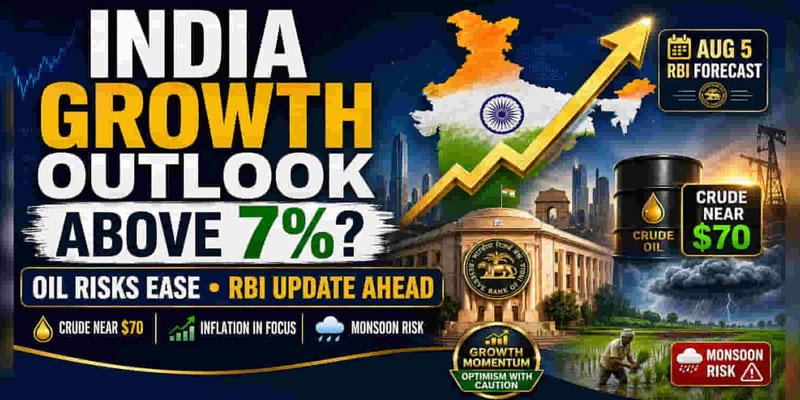
India’s economy could expand by more than 7 per cent this year, surpassing the Reserve Bank of India’s (RBI) current growth forecast, if crude oil prices remain close to $70 a barrel and geopolitical tensions in West Asia continue to ease. That assessment comes from Nagesh Kumar, an external member of the RBI’s Monetary Policy Committee (MPC), who believes favorable global conditions could significantly strengthen India’s growth trajectory.
His remarks offer a more optimistic outlook than the RBI’s current baseline projection and underscore the critical role that energy prices and geopolitical stability play in shaping India’s economic performance.
A Resilient Economy Facing External Challenges
India entered this phase with considerable economic momentum. Official data and several international forecasts indicated growth exceeding 7 per cent during parts of FY26, reinforcing the country's status as one of the world’s fastest-growing major economies.
However, rising geopolitical tensions in West Asia and concerns over volatile crude oil prices prompted the RBI to adopt a more cautious stance for FY27. Given India’s dependence on imported energy, any disruption in oil-producing regions can have immediate consequences for inflation, trade balances and overall economic stability.
As tensions in West Asia escalated earlier, policymakers warned of higher fuel costs, commodity inflation and supply-chain disruptions. The recent easing of these tensions has altered that outlook, improving the balance between inflation management and economic growth.
Why Crude Oil Prices Matter So Much
For India, oil prices remain one of the most influential external variables. The country imports the majority of its crude oil requirements, making global energy markets a key determinant of domestic inflation and economic health.
Lower oil prices typically reduce transportation and production costs, helping to contain inflation across sectors. This, in turn, boosts household purchasing power and supports consumer spending—an important engine of economic growth.
According to Kumar, if crude prices remain subdued and regional stability is maintained, inflationary pressures could ease significantly. Such conditions would create a more favorable environment for businesses, consumers and policymakers alike, potentially enabling India to return to a growth path exceeding 7 per cent.
RBI’s Current Position and Recent Developments
The RBI’s latest monetary policy review projects GDP growth of 6.6 per cent for FY27 and consumer inflation of 5.1 per cent. The central bank has cited elevated oil prices and geopolitical uncertainties as key risks to both growth and price stability.
RBI Governor Sanjay Malhotra has also cautioned that inflation could accelerate if higher fuel costs spread through the broader economy.
Despite these concerns, recent declines in crude prices and signs of reduced tensions in West Asia have improved market sentiment. Analysts believe these developments could ease pressure on the rupee, strengthen macroeconomic stability and support corporate profitability.
Key Risks to the Outlook
While domestic demand, investment activity and credit growth remain resilient, India’s economic outlook is still vulnerable to global shocks. Any renewed conflict in West Asia or sharp rise in crude prices could quickly reverse recent gains and force policymakers to maintain a tighter monetary stance.
Opportunity Hinges on Global Stability
Nagesh Kumar’s assessment represents a conditional but encouraging scenario for India’s economy. The country’s long-term growth fundamentals remain strong, supported by robust domestic demand and structural reforms. However, achieving growth above 7 per cent will depend largely on factors beyond India’s borders—particularly oil prices and geopolitical stability in West Asia. If both remain favorable, India could once again outperform expectations and reinforce its position as a leading global growth engine.
(With agency inputs)