
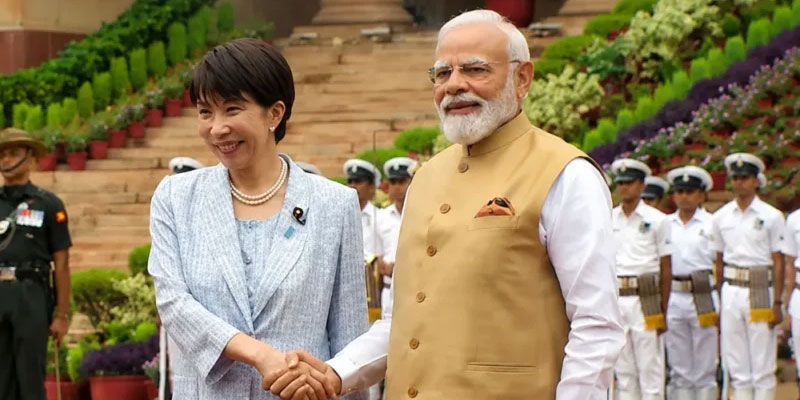
Japanese Prime Minister Arrives in New Delhi for Key Summit
Japanese Prime Minister Sanae Takaichi has arrived in New Delhi for the 16th India-Japan Annual Summit, where she and Prime Minister Narendra Modi are expected to discuss expanding trade, technology partnerships, and defence cooperation. The high-level engagement comes at a time when both countries are seeking to translate their long-standing strategic partnership into tangible economic and security outcomes. With discussions spanning semiconductors, resilient supply chains, clean energy, maritime security, and critical technologies, the summit is expected to reinforce not only bilateral ties but also the broader vision of a stable and resilient Indo-Pacific region.
A Partnership Built on Trust and Shared Interests
India and Japan today describe their relationship as a Special Strategic and Global Partnership, reflecting decades of cooperation founded on mutual trust, democratic values, technological collaboration, and converging security interests.
The summit follows Prime Minister Narendra Modi's visit to Tokyo in August 2025 and marks Prime Minister Takaichi's first official visit to India since assuming office, lending additional diplomatic significance to the meeting. Before formal discussions commenced, both leaders introduced their respective ministerial teams and official delegations at Rashtrapati Bhavan, highlighting that the visit is intended as a substantive working summit rather than a ceremonial engagement.
Over the years, bilateral cooperation has steadily expanded beyond traditional diplomacy. The agenda now encompasses trade and investment, defence, maritime security, high-speed rail, digital technologies, pharmaceuticals, critical minerals, infrastructure development, and clean energy. This broadening partnership reflects both nations' determination to strengthen economic resilience amid evolving geopolitical uncertainties and global supply-chain disruptions.
Key Areas of Cooperation
Rather than producing a single landmark agreement, the summit is widely expected to yield a comprehensive roadmap for future collaboration across multiple sectors.
Possible memoranda of understanding are likely to cover artificial intelligence, semiconductor manufacturing, battery technologies, critical minerals, green energy, pharmaceuticals, and industrial value chains. These initiatives complement India's manufacturing ambitions while providing Japan with reliable production partnerships outside China-centric supply chains.
Defence cooperation is also expected to receive considerable attention. Previous collaboration, including work on the UNICORN integrated mast for Indian Navy vessels, has demonstrated growing confidence in technology transfer and co-development. Future discussions may further strengthen maritime cooperation and defence-industrial partnerships.
Infrastructure remains another major pillar of the relationship. Japan has consistently been among India's leading providers of long-term infrastructure finance and advanced engineering expertise. Fresh commitments could focus on connectivity projects linking the Bay of Bengal with India's Northeast while supporting broader regional manufacturing ecosystems.
Discussions Underway
According to the latest updates, Prime Minister Takaichi has begun bilateral discussions with Prime Minister Modi in New Delhi, with both sides reviewing cooperation across strategic, economic, technological, and security sectors. Officials expect the summit to conclude with a joint statement outlining future priorities, accompanied by several sector-specific agreements aimed at deepening collaboration.
Beyond immediate announcements, the meeting is expected to inject renewed political momentum into bilateral engagement and accelerate implementation of existing projects while identifying new areas for cooperation in emerging technologies and industrial development.
Strengthening a Future-Oriented Strategic Partnership
The 16th India-Japan Annual Summit reflects the steady evolution of one of Asia's most important strategic relationships. By combining economic cooperation, technological innovation, infrastructure development, and defence collaboration, both countries are positioning themselves to address shared geopolitical and economic challenges. Even if the summit produces incremental agreements rather than headline-making treaties, its long-term significance lies in reinforcing a partnership anchored in trust, resilience, and a common commitment to a free, open, and rules-based Indo-Pacific.
(With agency inputs)