
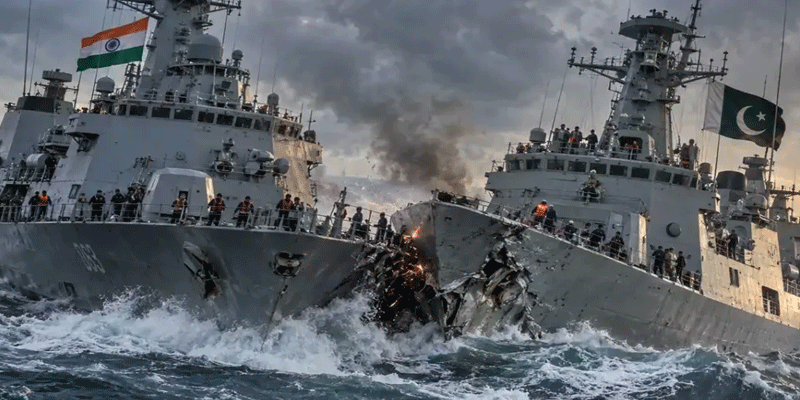
A Pakistani naval vessel collided with an Indian Navy warship in international waters of the North Arabian Sea on September 15, prompting New Delhi to summon Pakistan’s Charge d’Affaires and lodge a strong diplomatic protest. India described the conduct of the Pakistani naval unit as “unacceptable and unprofessional”, while stating that the incident caused no major damage.
High-Speed Manoeuvre Leads to Collision
According to Indian government sources, the incident occurred on Tuesday evening when a Pakistani naval ship approached an Indian frontline warship conducting a routine surveillance mission in the North Arabian Sea. The Pakistani vessel reportedly closed in at high speed and manoeuvred in what Indian sources described as an unsafe manner, resulting in a collision.
While the incident did not result in major damage, its occurrence between naval vessels belonging to two nuclear-armed neighbours carries particular significance because of the need for disciplined navigation and clear communication during military operations in international waters.
India Invokes The 1991 Bilateral Agreement
The Ministry of External Affairs said the Pakistani vessel’s conduct was in direct contravention of Article 10 of the April 1991 Agreement on Advance Notice on Military Exercises, Manoeuvres and Troop Movements. The agreement was established to improve transparency and reduce the possibility of accidents or misunderstandings between the armed forces of the two countries.
India conveyed that military units must:
· Exercise due care during operations.
· Respect applicable bilateral agreements.
· Take steps to prevent similar incidents from recurring.
Pakistan’s Charge d’Affaires Saad Ahmad Warraich was summoned to the MEA and asked to communicate New Delhi’s concerns to the relevant authorities in Islamabad. India also instructed its Charge d’Affaires in Islamabad to lodge a parallel protest with Pakistan’s Foreign Ministry.
Why Maritime Encounters Carry Wider Risks
Indian and Pakistani naval forces operate in the Arabian Sea, including areas associated with surveillance, maritime security and other operations. Although the latest incident caused no major damage, close encounters between military vessels can create risks of miscalculation, particularly when bilateral relations are already strained.
The immediate diplomatic response therefore serves not only to register India’s objection but also to reinforce established protocols governing interactions between the two militaries.
A Reminder from Earlier Naval Tensions
The episode also recalls a 2011 incident involving the Pakistani Navy’s PNS Babur and the Indian Navy’s INS Godavari in the Gulf of Aden, when India had raised concerns over unsafe proximity between the vessels. The latest collision has consequently brought renewed attention to the importance of maritime conduct and communication mechanisms.
Preventing A Maritime Mishap from Becoming Larger
The September 15 collision remains a limited maritime incident, with India reporting no major damage. But its diplomatic handling reflects the sensitivity surrounding military interactions between India and Pakistan.
New Delhi’s decision to invoke the 1991 agreement places the episode within an established framework rather than leaving it solely as a navigational dispute. The immediate priority is therefore to ensure that naval units operating in overlapping maritime spaces maintain caution, communication and adherence to agreed norms.
In an already sensitive regional environment, preventing an avoidable encounter at sea from becoming a wider security crisis depends on disciplined operations and functioning diplomatic channels.
(With agency inputs)