

FCNR(B)-Led Inflows Strengthen India's External Financial Position
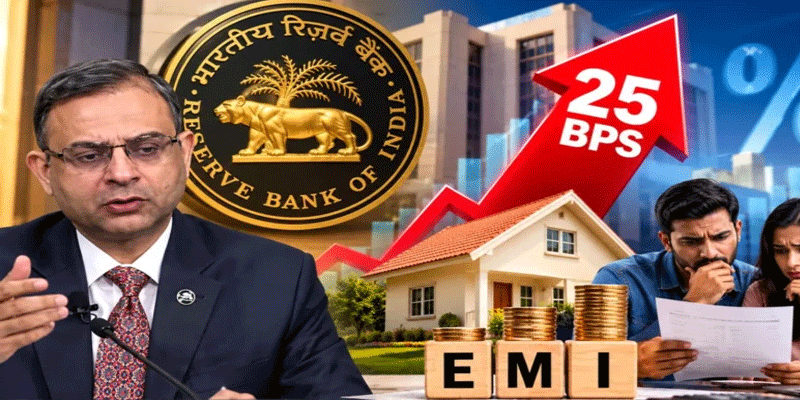
RBI measures have attracted nearly $32 billion in foreign inflows, largely through Foreign Currency Non-Resident (Bank) [FCNR(B)] deposits, reflecting the central bank's strategy of strengthening India's external buffers through confidence-building measures rather than relying solely on market intervention to defend the rupee. Highlighting the development, RBI Governor Sanjay Malhotra reiterated that the Reserve Bank continues to manage India's foreign exchange reserves on the guiding principles of safety, liquidity and returns, while periodically reviewing reserve deployment to ensure resilience against evolving global risks.
FCNR(B) Deposits as a Stable Source of Foreign Currency
FCNR(B) deposits are foreign currency-denominated deposits maintained by Non-Resident Indians (NRIs) with Indian banks. Since these deposits are held in foreign currencies, they help India attract overseas capital without exposing banks or depositors to immediate exchange-rate conversion risks. Policymakers have traditionally encouraged FCNR(B) deposits during periods of external uncertainty to strengthen the country's balance of payments and augment foreign exchange reserves with relatively stable inflows.
Understanding Foreign Exchange Reserves
Foreign exchange reserves are external assets held by a country's central bank to maintain financial stability and meet international payment obligations. India's reserves primarily comprise foreign currency assets, gold reserves, Special Drawing Rights (SDRs) allocated by the International Monetary Fund (IMF), and the country's reserve position with the IMF.
These reserves serve multiple purposes, including supporting the value of the rupee, financing imports during periods of external stress, meeting foreign debt obligations, and providing confidence to global investors regarding India's macroeconomic stability. Strong reserve levels also enable the RBI to intervene in currency markets whenever excessive volatility threatens financial stability.
How RBI's Reserve Strategy Is Delivering Results
According to Governor Sanjay Malhotra, the RBI's recent policy measures have generated nearly $32 billion in inflows, with FCNR(B) deposits accounting for the majority. Unlike volatile portfolio investments or speculative capital, these deposits generally represent longer-term foreign currency resources, giving the central bank greater flexibility in managing exchange-rate fluctuations and external financing needs.
Malhotra emphasised that the RBI continues to manage reserves under a conservative framework that prioritises capital preservation, ensures adequate liquidity to respond to market disruptions, and seeks reasonable returns only within those primary objectives. The central bank periodically reviews reserve deployment while maintaining diversified investments across currencies, asset classes and jurisdictions.
This diversification has become increasingly significant amid rising geopolitical tensions, global financial uncertainty and concerns over the possible "weaponization of reserves," where access to foreign assets could be restricted during conflicts or sanctions.
Building Resilience Beyond Market Intervention
The significance of the $32 billion inflow extends well beyond the headline figure. It indicates that India is strengthening its external financial position through carefully designed policy measures that mobilise durable foreign currency resources instead of depending excessively on short-term market borrowing.
FCNR(B)-led inflows enhance reserve adequacy, reinforce confidence in the rupee, and reduce the need for aggressive foreign exchange market interventions that could otherwise deplete reserves. Equally important, the RBI's reserve management philosophy demonstrates that its objective is not to maximise investment returns but to safeguard financial stability through prudent risk management, strict credit controls and diversified asset allocation.
Prudence Remains the RBI’s Strongest Financial Shield
The RBI's latest reserve management strategy underscores a measured and forward-looking approach to safeguarding India's external sector. By combining stable FCNR(B) inflows with disciplined reserve deployment, diversification and conservative investment principles, the central bank is enhancing the country's ability to withstand global financial shocks. As international capital flows remain volatile and geopolitical uncertainties persist, this strategy could prove instrumental in preserving macroeconomic stability, strengthening investor confidence and ensuring that India's foreign exchange reserves remain a robust shield against future external challenges.
(With agency inputs)