
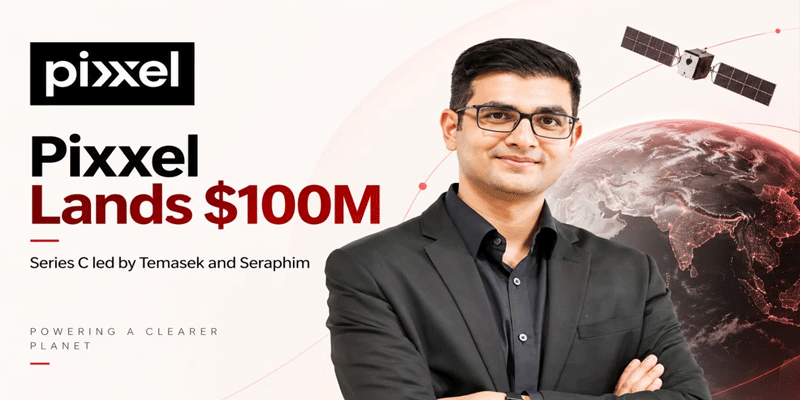
Bengaluru-based space-tech startup Pixxel has raised $100 million in its latest funding round, marking a major milestone for India’s rapidly evolving private space industry. The Series C round, led by Singapore’s Temasek and UK-based Seraphim Space, is the largest single funding round raised by an Indian space technology company, taking Pixxel’s total capital raised to $195 million.
From Student Venture to Space-Tech Pioneer
Founded in 2019 by BITS Pilani graduates Awais Ahmed and Kshitij Khandelwal, Pixxel emerged as India began opening its space sector to private enterprises. Its core technology focuses on hyperspectral imaging, which captures hundreds of narrow spectral bands rather than the limited bands used by conventional optical satellites.
This enables satellites to detect subtle changes in crops, water bodies, minerals and atmospheric gases, making the technology useful for identifying crop stress, methane emissions, illegal mining, water scarcity and environmental pollution.
Pixxel has evolved from an experimental startup into an integrated Earth-observation company. Its Firefly constellation currently comprises six hyperspectral satellites offering five-metre resolution imagery, while its next-generation Honeybee satellites are designed to add short-wave infrared capabilities. Its Aurora platform uses artificial intelligence and geospatial foundation models to convert satellite data into actionable intelligence.
$100 Million to Build a Larger Space Ecosystem
The fresh funding will be directed towards three key areas: expanding Pixxel’s satellite constellation, scaling Aurora and developing sovereign Earth-observation capabilities.
The company plans to increase its Firefly and Honeybee fleets while adding sub-metre-resolution optical imaging satellites. It also intends to strengthen in-house satellite manufacturing and systems integration, allowing greater control over the entire space-data pipeline.
Aurora is expected to become an increasingly important part of this strategy. By combining hyperspectral, optical and eventually radar datasets, Pixxel aims to move beyond simply selling satellite imagery and instead deliver decision-ready intelligence to sectors such as agriculture, energy, mining and government.
Investor Confidence Reflects India’s Space Momentum
The funding round also demonstrates growing international confidence in India’s private space ecosystem. Government reforms following 2020 opened the sector to private participation, with IN-SPACe providing an institutional framework for commercial space activity.
Investment into Indian space startups has accelerated, while projections indicate that India’s space economy could expand substantially by 2030. Pixxel’s latest raise therefore reflects a wider transition—from startups developing individual space technologies to companies building commercially viable, vertically integrated space businesses.
From Satellite Images to Planetary Intelligence
Pixxel’s biggest significance may lie in its attempt to combine satellites, AI and analytics into one planetary intelligence platform. As governments and corporations increasingly require real-time information on climate change, food security, natural resources and supply chains, high-resolution Earth observation is becoming strategically important.
The challenge now is to convert capital into sustained commercial scale. Faster approvals, stronger government procurement of indigenous Earth-observation data, launch infrastructure and support for dual-use technologies will be crucial.
Pixxel’s record funding is therefore more than a corporate success story. It signals India’s ambition to become not merely a participant in the global space economy, but a serious provider of the satellites, data and intelligence that will define it.
(With agency inputs)