
Why the Chicken’s Neck Is Strategically Vital
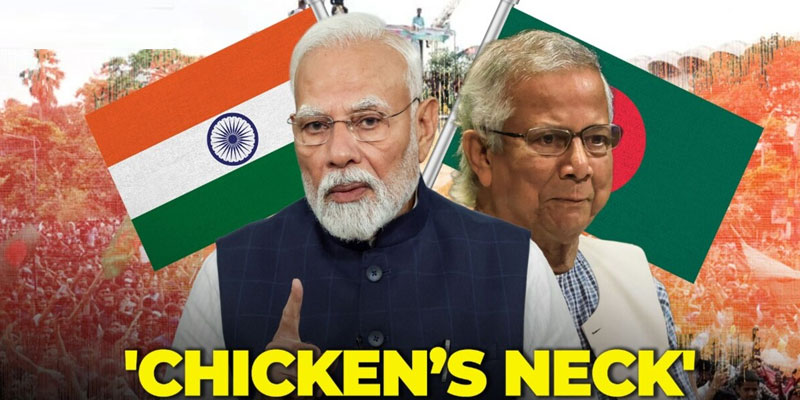
The Siliguri Corridor—often called the “Chicken’s Neck”—is far more than a cartographic curiosity. It is India’s only land bridge connecting the mainland to its eight northeastern states. Any disruption here would instantly fracture national connectivity, undermine security deployments, and choke economic lifelines. That is why recent remarks by Union Home Minister Amit Shah, delivered in Bagdogra in January 2026, were uncompromising: India’s sovereignty over this corridor is absolute, and rhetoric questioning it will not be tolerated.
Anatomy of a Chokepoint
Geographically, the corridor is a slender strip roughly 60 kilometres long and barely 20–22 kilometres wide at its narrowest point, running through northern West Bengal. It links the heartland to Arunachal Pradesh, Assam, Manipur, Meghalaya, Mizoram, Nagaland, Sikkim, and Tripura—home to around 50 million citizens. Nearly 90% of goods, fuel, food supplies, and military logistics to the Northeast pass through this passage via national highways, a critical rail line, and Bagdogra airport. Severing or destabilising it would isolate the region within hours.
A Zone of Persistent Vulnerability
The corridor’s sensitivity stems from its neighbourhood. Nepal lies to the west, Bhutan to the east, Bangladesh to the south, and China’s Chumbi Valley presses close from the north. This proximity has long made Siliguri a strategic pressure point. During the 1962 war, Chinese forces advanced alarmingly close; in 2017, the Doklam standoff again highlighted how quickly tensions near the tri-junction could threaten the corridor. Even diplomatic statements from neighbouring capitals periodically revive concerns about encirclement and coercive leverage.
Why Shah Took Aim at the Slogans
Against this backdrop, Amit Shah’s sharp reaction to slogans allegedly chanted during protests in Delhi—calling to “cut the Chicken’s Neck”—was deliberate and symbolic. Such language, even when voiced by fringe elements, strikes at the heart of India’s territorial integrity. Shah framed these slogans as not merely provocative speech but as challenges to sovereignty in one of the country’s most sensitive zones.
By invoking ongoing legal cases and pointing to judicial scrutiny, Shah sought to underline that the Indian state views any call—explicit or implicit—for dismembering strategic territory as anti-national. His remarks were also a political signal: debates over policy or governance are legitimate, but rhetoric that appears to endorse geographic rupture crosses a red line.
Political and Strategic Signalling
The timing of Shah’s comments—ahead of electoral contests in West Bengal—added a political dimension, energising supporters in a region where national security narratives resonate strongly. Yet the message extended beyond electoral mobilisation. It reinforced continuity with past decisions emphasising territorial unity, projecting an image of firmness to both domestic audiences and external observers watching India’s responses to regional realignments.
Security Architecture Around the Corridor
India has steadily reinforced the Siliguri axis through layered security deployments, improved infrastructure, and strategic deterrence assets in the broader eastern theatre. Border forces, surveillance upgrades, and rapid-mobility capabilities are complemented by efforts to develop alternative connectivity routes through Myanmar and maritime corridors. Still, none can fully substitute the Siliguri link in the near term.
Sovereignty Without Ambiguity
The Chicken’s Neck is not just a corridor—it is India’s strategic jugular. Amit Shah’s forceful rhetoric reflects an understanding shaped by geography, history, and contemporary geopolitics. In a region where words can inflame tensions as quickly as troops can move, the message is clear: India’s territorial integrity, especially at its most vulnerable points, is not open to negotiation, sloganizing, or ambiguity.
(With agency inputs)