
Reacting to the Budget, Rahul Gandhi said it failed to address pressing issues such as unemployment, distress in agriculture, declining household savings and weakening investor confidence.
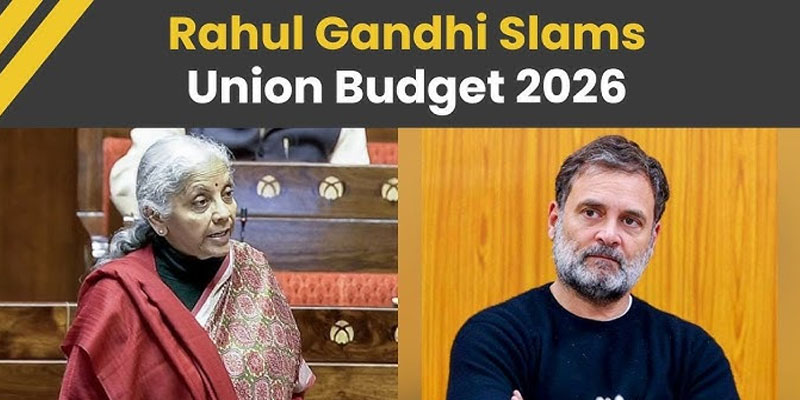
Congress leader and Leader of Opposition Rahul Gandhi on Sunday came down heavily on the Union Budget 2026, accusing the Narendra Modi government of ignoring India’s deepening economic and social crises and refusing to undertake course correction. Reacting to the Budget, Gandhi said it failed to address pressing issues such as unemployment, distress in agriculture, declining household savings and weakening investor confidence.
“Youth without jobs. Falling manufacturing. Investors pulling out capital. Household savings plummeting. Farmers in distress. Looming global shocks all ignored. A Budget that refuses course correction, blind to India’s real crises,” Gandhi said in a statement.
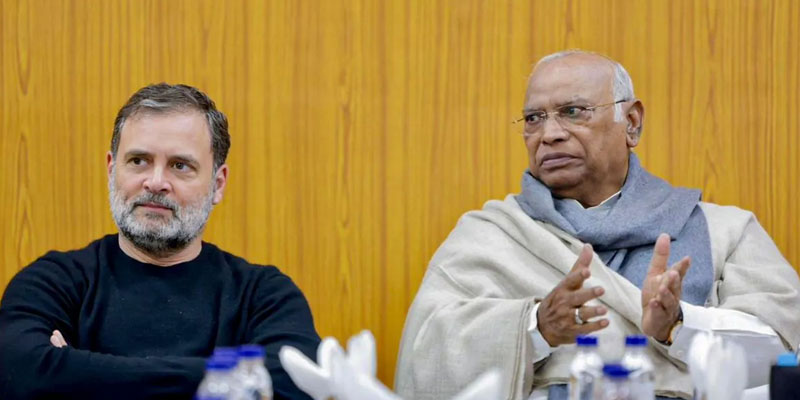
Congress President and Rajya Sabha LoP Mallikarjun Kharge reacting to it said, "The Modi government has run out of new ideas. This budget raises more questions than it answers regarding India's significant economic, social, and political challenges. It offers nothing for the poor. They have not presented any solution, positive suggestion, or concrete steps to control inflation. The Economic Survey indicates that trade uncertainty is a major challenge for India, yet the budget barely acknowledges this problem. Similarly, they have no plan to address the falling value of the rupee... The budget shows no intention of reviving consumer demand. The decline in domestic savings and the increasing burden of personal debt have also been ignored... there is no solution to the widespread unemployment crisis among educated youth. The Finance Commission's recommendations require further study, but they do not appear to provide any relief to state governments facing serious financial constraints. Inequality has surpassed the levels seen during the British Raj. But the budget doesn't even mention it. Nor have they made any provision for assistance for Scheduled Castes, Scheduled Tribes, Other Backward Classes, Economically Weaker Sections, or minorities..."
PM Modi calls budget ‘historic’, women-centric
Prime Minister Narendra Modi, however, described the Union Budget 2026 as “historic,” saying it reflects strong women empowerment and accelerates India’s reform journey. Praising Finance Minister Nirmala Sitharaman for presenting her ninth consecutive Union Budget, PM Modi said the Budget transforms aspirations into reality and lays a solid foundation for future growth.
“Today’s budget is historic. It reflects the strong empowerment of the nation’s women power,” the Prime Minister said, adding that the Budget acts like a “highway of immense opportunities.” Calling the moment significant, the Prime Minister said Sitharaman had created history by presenting the Budget for the ninth time as a woman Finance Minister.
“This budget gives new energy and momentum to the reform express on which India is riding today,” he said.
Budget 2026
Presenting the Budget in Parliament, Finance Minister Nirmala Sitharaman announced multiple tax reforms aimed at simplifying compliance and improving ease of living. Key measures include income tax exemption on interest awarded by Motor Accident Claims Tribunals (MACT), reduction of TCS on overseas tour packages to 2 per cent, and rationalisation of TCS rates for liquor, scrap and mineral sellers.
The Budget also proposes higher excise duty and a new cess on tobacco products, making cigarettes and pan masala costlier, while trading in futures and options becomes more expensive due to a hike in Securities Transaction Tax.
Make in India push
To promote domestic manufacturing, the government withdrew import duty exemptions on certain industrial machinery where domestic capacity exists. While aligned with the ‘Make in India’ initiative, the move may raise costs for industries dependent on cheaper imports.
The Finance Minister also announced restructuring of the National Calamity Contingent Duty on select tobacco products, effective May 1, 2026, without increasing the overall tax burden on consumers.