Centre Says 17 Crore Jobs Created in a Decade
Amid growing concerns over unemployment among India's Gen Z, the Centre has asserted that the country generated more than 17 crore employment opportunities between 2014 and 2024. Labour and Employment Minister Mansukh Mandaviya, while responding in Parliament, cited the Reserve Bank of India's KLEMS database to claim that employment has expanded significantly over the past decade. While the government views the figures as evidence of sustained economic growth and job creation, the announcement has reignited debate over the quality, security and nature of employment available to India's rapidly expanding young workforce.
What the Employment Data Indicates
The government attributes this growth to rapid expansion across manufacturing, infrastructure, construction, services, agriculture and self-employment. It argues that initiatives such as infrastructure development, industrial growth, digital transformation and entrepreneurship promotion have broadened employment opportunities under Prime Minister Narendra Modi's administration.
However, economists caution against equating the figure with 17 crore new formal jobs. The KLEMS database measures overall employment participation rather than regular salaried employment. It includes self-employed workers, informal labour, unpaid family workers and those engaged in seasonal or short-duration economic activities. Consequently, the numbers reflect workforce participation rather than exclusively stable, well-paying jobs with social security benefits.
Why Gen Z Remains Skeptical
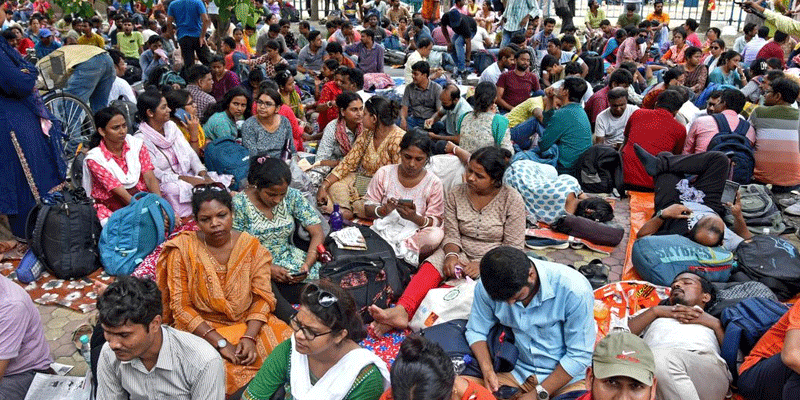
Despite the government's optimistic assessment, employment remains one of the biggest concerns for India's youth. Recent examination-paper leaks, intense competition for government jobs and limited vacancies in the formal sector have amplified anxiety among educated young people.
According to the Periodic Labour Force Survey (PLFS) 2023-24, unemployment among people aged 15-29 years stood at 10.2%, with the rate higher for young women (11%) than for young men (9.8%). The youth Worker Population Ratio of 41.7% also indicates that a substantial proportion of young Indians remain outside the workforce or continue pursuing higher education.
The India Employment Report 2024, prepared by the International Labour Organization (ILO) and the Institute for Human Development (IHD), highlights another worrying trend. It found that unemployment actually rises with educational attainment. Graduate unemployment stood at 29.1%, while educated youth accounted for nearly 66% of all unemployed persons. These findings underscore the growing mismatch between educational qualifications and available employment opportunities.
Government's Policy Push
To address these challenges, the Centre has linked its employment strategy to industrial expansion, skill development, manufacturing incentives and entrepreneurship. In the Union Budget 2024-25, the government announced five employment-linked schemes with an outlay of ₹2 lakh crore, aimed at benefiting 4.1 crore young people over five years through skilling, internships, employment support and job creation initiatives.
The government believes these measures will improve employability while encouraging greater participation in emerging sectors of the economy.
Beyond Numbers Lies the Real Challenge
The parliamentary statement offers an encouraging macroeconomic picture, but it also highlights the complexity of measuring employment in a rapidly evolving economy. While overall workforce participation may have risen substantially, India's young population is seeking more than statistical inclusion—they aspire to secure, well-paid, skill-oriented and future-ready careers. Ultimately, the success of India's employment story will be judged not merely by the number of people counted as employed, but by the quality, dignity and sustainability of the opportunities available to the nation's next generation.
(With agency inputs)