

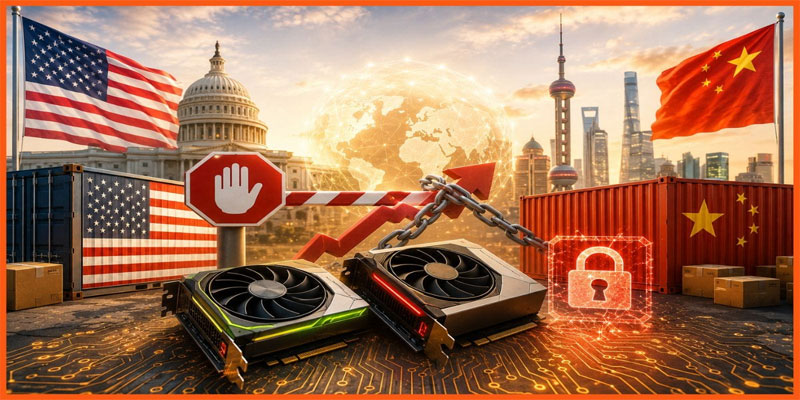
The Trump administration has introduced tougher restrictions on advanced artificial intelligence chips, targeting loopholes that allowed Chinese companies to access American computing power through overseas data centres.
The US Commerce Department announced an interim rule on November 16, 2026, aimed at preventing companies headquartered in China and other restricted countries from remotely accessing sensitive semiconductor technology.
The restrictions specifically address arrangements where Chinese businesses rent computing capacity from foreign data centres equipped with Nvidia's advanced processors, potentially bypassing existing export controls.
Under the revised framework, exports and transfers of advanced semiconductors to Singapore, Malaysia, Indonesia, Thailand, and Brazil will face additional licensing requirements to reduce diversion risks.
The Commerce Department acknowledged that the rule was drafted under the direction of the Treasury Department and National Security Council, highlighting disagreements within President Donald Trump's administration.
Commerce Secretary Howard Lutnick has faced mounting criticism over his department's handling of Nvidia exports, particularly allegations involving Singapore-based technology company Megaspeed International.
US authorities have investigated whether Megaspeed facilitated access to restricted Nvidia chips for Chinese customers. However, the allegations remain disputed, and wrongdoing has not been established.
Senator Maria Cantwell accused the Commerce Department of failing to close regulatory gaps despite warnings that Chinese companies could exploit overseas computing infrastructure to advance artificial intelligence development.
The controversy follows Nvidia's leadership crisis and Jensen Huang's resignation, intensifying scrutiny of corporate governance, export compliance, and relationships between technology companies and government officials.
Financial markets reacted negatively to the restrictions, with Nvidia and other semiconductor companies facing selling pressure amid concerns about reduced international demand and increased regulatory uncertainty.
The larger implication is that America's semiconductor strategy is shifting from controlling physical chip shipments to regulating access to computing power itself. While tighter oversight could protect sensitive technologies, excessive restrictions may accelerate China's domestic semiconductor development. Effective enforcement will require international cooperation, transparent licensing, and stronger verification of end users without unnecessarily undermining legitimate global AI innovation.