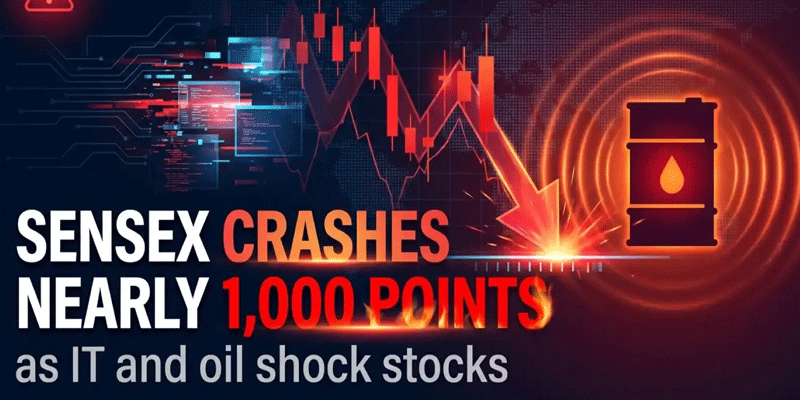


Indian equity markets staged a powerful rally on Monday as easing geopolitical tensions in the Middle East and a sharp fall in crude oil prices lifted investor sentiment across Dalal Street. The BSE Sensex surged nearly 1,200 points while the NSE Nifty reclaimed the crucial 24,000 mark after reports of a preliminary US-Iran peace agreement triggered a global risk-on mood. The decline in oil prices brought significant relief for India, one of the world’s largest crude importers, with investors betting on lower inflation, a stronger rupee, and improved economic stability.
Asian Markets Rally After Landmark US-Iran Peace Breakthrough
Asian stock markets surged sharply on Monday after news emerged that the United States and Iran had reached a preliminary peace agreement to end the prolonged Middle East conflict. In India, the BSE Sensex jumped nearly 1,200 points while the NSE Nifty reclaimed the crucial 24,000 mark, as falling crude oil prices triggered a broad-based risk-on rally across global financial markets. The breakthrough deal, expected to be formally signed in Switzerland later this week, also pushed Brent crude prices below $84 per barrel after months of geopolitical volatility.
Why Global Investors Turned Risk-On
The strongest trigger for the rally was the agreement’s commitment to reopen the Strait of Hormuz within 30 days. This significantly reduced fears of prolonged energy supply disruptions and erased much of the geopolitical premium built into oil prices.
Brent crude fell more than 4 percent to nearly $83.70 per barrel, providing immediate relief to oil-importing economies. Lower oil prices are expected to ease inflationary pressures, reduce import costs, and improve fiscal balances across Asia.
Investors also interpreted the agreement as reducing broader geopolitical uncertainty, encouraging fresh capital inflows into equities and other risk-sensitive assets. Expectations that central banks may avoid aggressive interest rate hikes further strengthened market sentiment.
Asian Markets Today
The rally was widespread across Asia’s major financial centres.
In Japan, the Nikkei 225 surged nearly 5 percent, gaining over 3,400 points to approach the 69,500 level. South Korea’s Kospi jumped 5.7 percent, while Hong Kong’s Hang Seng Index advanced more than 2.5 percent. China’s Shanghai Composite also closed firmly in positive territory.
For India, which imports nearly 85 percent of its crude oil requirements, the decline in energy prices carries major macroeconomic implications. Analysts estimate that every $10 drop in crude prices can save the country billions of dollars in import expenses, helping stabilize the rupee, ease inflation, and protect economic growth.
Risks and Uncertainties Remain
Despite the optimism, investors remain cautious because the agreement is still preliminary. The final signing has yet to take place, and many operational details remain unclear. Markets are also aware that geopolitical negotiations can change rapidly, particularly in the Middle East.
Markets Betting on Stability and Lower Energy Costs
The sharp rally across Asian markets reflects more than temporary optimism — it signals a reassessment of global economic risk. By easing fears around the Strait of Hormuz and reducing energy uncertainty, the US-Iran agreement has revived investor confidence across the region. For oil-dependent economies like India, the development represents not just a market rebound, but the possibility of renewed economic stability after months of geopolitical strain.
(With agency inputs)