₹44,000 Crore Wiped Out in One Trading Session
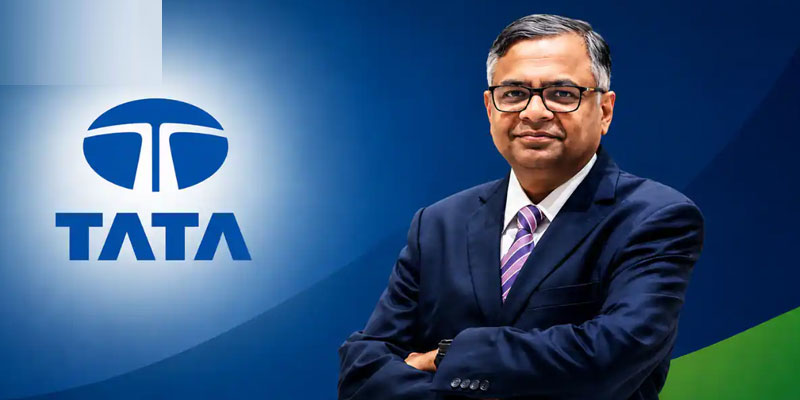
Tata Group stocks suffered a sharp sell-off on August 12 after N. Chandrasekaran announced that he would not seek reappointment as Tata Sons chairman when his current term ends in February 2027. The announcement erased roughly ₹44,000–46,000 crore in combined market value, underscoring how strongly investors had come to associate the conglomerate’s strategic direction with his leadership.
Tata Consultancy Services (TCS) bore the brunt, falling as much as 5–6% and accounting for more than ₹41,000 crore of the market-value erosion. Tata Motors Passenger Vehicles, Tata Steel, Tata Consumer Products and Tejas Networks also declined sharply. The immediate reaction was less about the operating performance of individual companies and more about uncertainty over succession, governance and future strategy.
Why Chandrasekaran’s Exit Matters
Chandrasekaran became Tata Sons chairman in February 2017 after heading TCS, and his tenure coincided with an ambitious restructuring of the sprawling conglomerate. His decision follows months of uncertainty over his reappointment. He said the proposal had failed to secure unanimous board support and that prolonged ambiguity made leadership clarity necessary for employees, investors and other stakeholders.
The development is significant because Tata Sons controls a diverse empire spanning technology, automobiles, steel, aviation, retail, consumer products, power and emerging businesses such as semiconductors. The succession process will therefore be closely watched for signals about capital allocation and strategic continuity.
Which Tata Stocks Created Most Wealth?
Chandrasekaran’s tenure also produced striking gains across several listed Tata companies. Market analysis cited by the group’s coverage indicate that aggregate market capitalisation expanded more than threefold during his chairmanship, while numerous companies generated multi-bagger returns.
The standout wealth creators included:
· Trent: surged roughly 1,700%, powered by the rapid expansion of Tata’s retail businesses.
· NELCO: gained around 1,140%, reflecting growth expectations in satellite communications and infrastructure-related opportunities.
· Tata Investment Corporation: rose approximately 1,060%, benefiting from the revaluation of its investment portfolio.
· Titan Company: advanced more than 1,020%, driven by sustained jewellery and watches growth.
· Tata Consumer Products: gained about 670%, supported by consolidation, premiumisation and a stronger consumer portfolio.
Several other Tata stocks also more than doubled, demonstrating that the wealth creation was not confined to TCS or Titan.
What Is N. Chandrasekaran’s Net Worth?
Chandrasekaran’s exact personal net worth is not officially disclosed, so widely circulated estimates should be treated cautiously. Media estimates have placed it broadly around $100–150 million, but these figures are not independently verified.
What is officially documented is his remuneration. Tata Sons’ FY26 annual report shows he received ₹158.66 crore in total remuneration, including ₹17.97 crore in salary and benefits and ₹140.69 crore in profit-linked commission. His cumulative remuneration over the five years to FY26 reached ₹671.4 crore.
The Real Test Begins with Succession
The market shock demonstrates that investors are not merely reacting to one executive’s departure; they are pricing uncertainty around Tata’s next chapter. The group’s independent listed companies remain fundamentally different businesses, but leadership continuity matters for major long-term bets. The immediate sell-off may fade, but Tata’s next leader must prove that Chandrasekaran’s decade of transformation can continue without losing strategic momentum.
(With agency inputs)