

India is on the verge of concluding what could become one of the largest and most consequential defence acquisitions in its history. The government has reportedly finalised a Letter of Request (LoR) to France for the procurement of 114 Dassault Rafale fighter jets, while simultaneously pressing for significant domestic manufacturing and technology transfer. A key demand is that up to 50 per cent of the aircraft’s content be sourced from India, underscoring New Delhi’s determination to combine military modernisation with indigenous industrial development.
A Landmark Defence Acquisition in the Making
The proposed deal represents far more than a conventional fighter-aircraft purchase. It is being designed as a long-term strategic partnership between India and France, aimed at strengthening the Indian Air Force (IAF) while expanding India's aerospace manufacturing capabilities.
Under the broad framework under discussion, India plans to acquire 114 Rafale fighter jets, substantially enhancing its combat aviation strength. The move comes at a time when the IAF continues to operate below its sanctioned squadron strength, creating an urgent requirement for advanced multi-role fighter aircraft capable of addressing evolving regional security challenges.
The Rafale, already in service with the IAF, has demonstrated its operational capabilities and is viewed as a proven platform for future force expansion.
The “Make in India” Dimension
A defining feature of the proposed agreement is its emphasis on domestic production.
Of the 114 aircraft, nearly 90 are expected to be manufactured in India through a joint production arrangement involving Dassault Aviation and an Indian industrial partner. Industry observers widely believe Tata Advanced Systems Limited could play a major role, given its existing involvement in Rafale component manufacturing.
The remaining aircraft are expected to be delivered in fly-away condition, ensuring that operational requirements are met while domestic production infrastructure is established and scaled up.
Importantly, India is seeking to ensure that as much as 50 per cent of the aircraft’s overall content—including certain components, systems, and possibly weapons-related elements—is produced locally. Such a provision would significantly deepen India's participation in the global aerospace supply chain.
Strengthening the Air Force and Defence Industry
The deal addresses two strategic objectives simultaneously.
· First, it seeks to bridge the capability gap faced by the Indian Air Force. With ageing fleets gradually being phased out and operational demands increasing, the acquisition of additional Rafales would strengthen India's air-combat readiness.
· Second, local production offers an opportunity to build long-term industrial capabilities. Manufacturing advanced fighter aircraft in India could accelerate expertise in areas such as avionics integration, composite materials, systems engineering, maintenance support, and aerospace logistics.
These capabilities are also expected to complement indigenous defence programmes such as the Tejas Mk-2 and future advanced fighter projects, helping Indian industry move up the technological value chain.
Cost, Strategic Partnerships and Future Challenges
Estimated at around ₹3.25 lakh crore, the package is expected to include aircraft procurement, weapons systems, training, maintenance infrastructure, and industrial collaboration. This would make it one of the costliest defence agreements ever pursued by India.
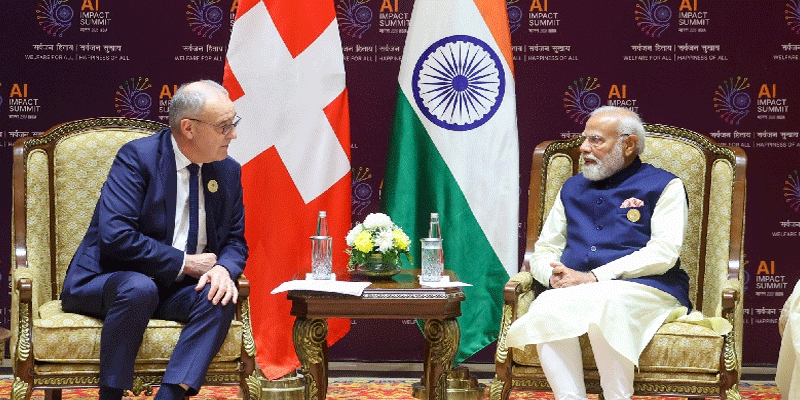
Beyond the financial dimension, the project further strengthens India's strategic partnership with France, a country that has emerged as a reliable defence and technology partner over the years.
However, the success of the initiative will depend on meaningful technology transfer, efficient execution, and the ability of Indian industry to absorb and utilise advanced manufacturing capabilities.
A Test of India’s Defence Manufacturing Ambitions
The proposed Rafale-114 programme is not merely about acquiring more fighter aircraft; it is about reshaping India’s defence-industrial landscape. If executed successfully, it could significantly enhance the Air Force’s operational strength while creating a foundation for advanced aerospace manufacturing within the country. Ultimately, the project will serve as a crucial test of whether India can move beyond being one of the world’s largest defence importers and emerge as a credible producer of high-end military aviation systems.
(With agency inputs)