

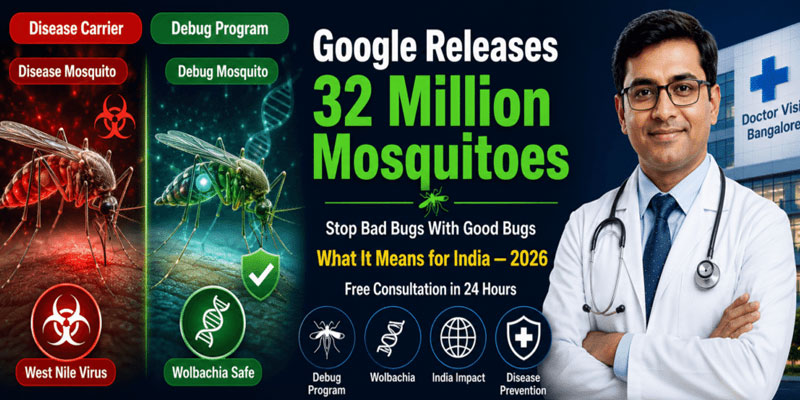
Google Seeks Approval to Release Sterilized Mosquitoes
Google’s parent company Alphabet, through its life sciences subsidiary Verily, has sought permission from US authorities to release millions of sterilized mosquitoes across California and Florida as part of an ambitious effort to combat mosquito-borne diseases such as dengue, Zika, chikungunya, and West Nile virus. The proposal, currently under review by the US Environmental Protection Agency (EPA), aims to use science rather than chemicals to suppress populations of disease-carrying mosquitoes.
The initiative, known as the Debug Project, represents a novel intersection of technology, biotechnology, and public health, highlighting how unconventional solutions are increasingly being explored to tackle global disease challenges.
Why Mosquito-Borne Diseases Remain a Global Threat
Mosquitoes are among the deadliest creatures in the world, not because of their size but because of the diseases they transmit. The Aedes aegypti mosquito, in particular, is responsible for spreading illnesses such as dengue fever, Zika virus, yellow fever, and chikungunya.
Climate change, urbanization, and increased international travel have expanded the geographic reach of mosquito populations, raising concerns among public health authorities. Traditional mosquito-control measures, including insecticide spraying and habitat elimination, have achieved varying degrees of success but often face limitations such as insecticide resistance and environmental concerns.
The Debug Programme: Fighting Mosquitoes with Mosquitoes
The Debug Project, developed by Verily, seeks to reduce mosquito populations by releasing male mosquitoes infected with a naturally occurring bacterium known as Wolbachia.
Importantly, male mosquitoes do not bite humans and cannot transmit diseases. Their role in the programme is purely reproductive. When these Wolbachia-infected males mate with wild female mosquitoes, the resulting eggs fail to hatch due to a biological phenomenon known as cytoplasmic incompatibility. Over time, repeated releases reduce the number of viable offspring, leading to a gradual decline in the target mosquito population.
The project specifically focuses on Aedes aegypti, one of the world's most efficient disease vectors.
EPA Review and Planned Releases
According to the proposal under review, Verily is seeking approval to release up to 64 million mosquitoes over a two-year period across selected areas in California and Florida.
The EPA is evaluating the request through a formal regulatory process that includes public consultation, environmental assessments, and safety reviews. Regulators are examining whether the programme can effectively reduce disease risks while avoiding unintended ecological consequences. If approved, the project would involve phased releases alongside extensive monitoring to measure population changes and assess effectiveness.
Potential Impacts and Public Health Significance
Supporters argue that the approach offers several advantages over conventional mosquito-control strategies. Unlike chemical insecticides, the Wolbachia method is highly targeted and does not rely on widespread pesticide use.
Scientific assessments by health and environmental agencies have indicated that Wolbachia poses no known threat to humans, animals, or ecosystems. Because the bacterium occurs naturally in many insect species, researchers view it as a relatively safe biological control tool.
If successful, the programme could provide a scalable and environmentally sustainable method for reducing the transmission of mosquito-borne diseases. It may also serve as a model for other countries struggling with recurring outbreaks of dengue, Zika, and similar illnesses.
A New Frontier in Disease Prevention
The Debug Project illustrates how innovative science is reshaping public health strategies. By targeting mosquito reproduction rather than attempting to eliminate insects through chemicals, the initiative offers a potentially transformative approach to disease control. While regulatory scrutiny and environmental monitoring remain essential, the proposal underscores a growing recognition that future health challenges may require solutions that blend biotechnology, data-driven research, and ecological sustainability. If proven effective, the release of “good” mosquitoes could become an important tool in the global fight against mosquito-borne diseases.
(With agency inputs)