

Why Enterprises Must Adopt Quantum-Ready and AI-Driven Security Frameworks
The implementation of India’s Digital Personal Data Protection (DPDP) Act has significantly increased awareness around data privacy, governance, and compliance. However, many organizations still believe that regulatory compliance alone is sufficient to ensure protection. The reality is far more complex. Privacy without security is unsustainable, especially in an era where cybercriminals are leveraging artificial intelligence to launch highly sophisticated attacks. Deepfake frauds, synthetic identities, intelligent impersonation, and AI-powered cyber deception are rapidly becoming major threats to enterprises, financial institutions, and critical infrastructure sectors worldwide.
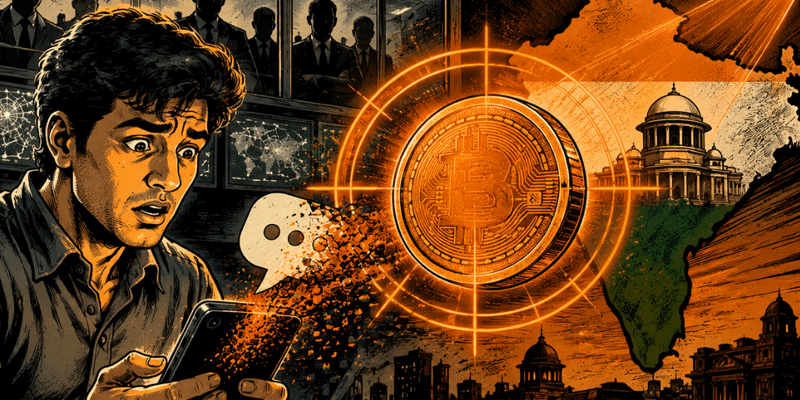
The challenge is further intensified by the emergence of quantum computing. Traditional encryption technologies such as RSA and AES, which currently secure global digital ecosystems, are expected to become vulnerable to quantum-enabled attacks in the near future. As a result, governments and regulators across the world are accelerating preparations for Post-Quantum Cryptography (PQC). In India, advisory alerts from the Ministry of Finance, Ministry of Electronics and Information Technology, RBI, SEBI, and CERT-In have already highlighted the need for organizations to strengthen cybersecurity frameworks against next-generation threats. Concerns around advanced AI ecosystems such as MYTHOS, QWIN, and other superintelligent platforms have also increased the urgency for enterprises to rethink their cyber defense strategies.
One of the most alarming developments in this landscape is the rapid rise of synthetic fraud driven by deepfake technologies. Cybercriminals can now generate hyper-realistic audio, video, facial identities, and conversational patterns capable of bypassing traditional authentication systems. These AI-generated identities are increasingly being used to manipulate banking transactions, execute executive impersonation scams, compromise digital onboarding systems, and infiltrate enterprise workflows. Conventional fraud management systems, built on static rules and historical patterns, are struggling to detect these evolving AI-driven attacks.
In response to this growing challenge, Faceoff Technologies is emerging as a leading innovator in AI-powered cybersecurity and deepfake fraud prevention. The company has developed an advanced security framework powered by homegrown Agentic RAG (Retrieval-Augmented Generation) architecture integrated with naturally inspired algorithms capable of detecting suspicious behavioral and contextual anomalies in real time. Unlike traditional cybersecurity solutions, Faceoff Technologies combines adaptive intelligence, contextual analytics, and real-time threat correlation to proactively identify synthetic fraud attempts before they impact enterprise systems.
Its advanced deepfake detection engine evaluates multiple intelligence layers including facial behavior, voice modulation, transaction anomalies, contextual authenticity, and behavioral inconsistencies to accurately detect fraudulent interactions. The platform also leverages customized algorithms integrated with Small Language Models (SLMs), enabling enterprises to deploy lightweight, domain-specific, and privacy-centric AI security frameworks. This helps organizations strengthen fraud prevention while ensuring sensitive enterprise data remains protected within secure ecosystems.
Beyond fraud detection, Faceoff Technologies is also helping enterprises prepare for the quantum era by aligning security strategies with post-quantum readiness, AI governance, and continuous threat intelligence. By integrating deepfake detection, adaptive AI security, forensic analytics, and quantum-resilient approaches, the company is building a future-ready cybersecurity ecosystem designed for the evolving digital economy.
As synthetic intelligence continues to reshape the cyber threat landscape, enterprises can no longer depend solely on compliance-driven security models. The future of digital trust will belong to organizations that embrace intelligent, adaptive, and quantum-ready cybersecurity frameworks capable of defending against AI-powered fraud, cyber deception, and next-generation digital risks.