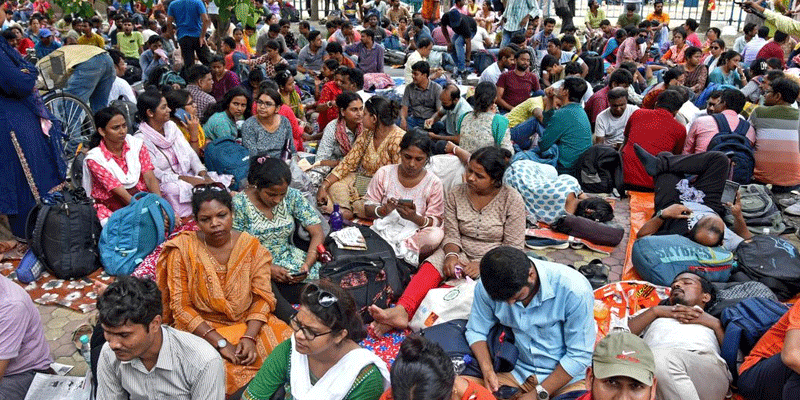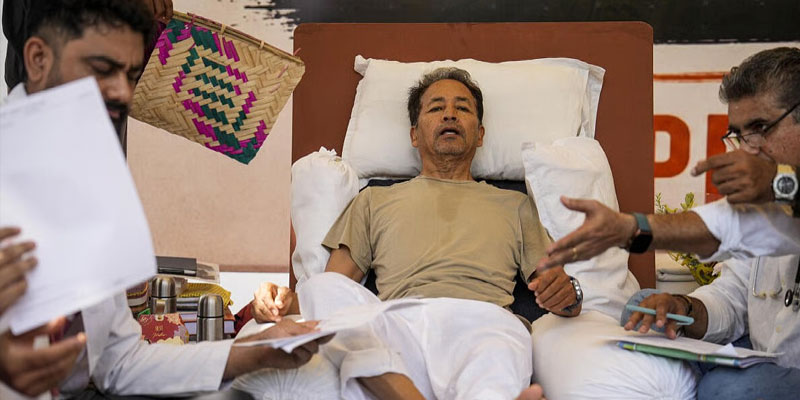
The Delhi High Court has directed the Centre and the Delhi government to ensure the health and safety of noted education reformer and climate activist Sonam Wangchuk, who has been on an indefinite hunger strike at Jantar Mantar. The court's intervention comes amid mounting concerns over his deteriorating health as his protest enters a critical phase. Wangchuk's fast, demanding the resignation of Union Education Minister Dharmendra Pradhan over alleged irregularities in the NEET examination, has evolved into a wider national debate on accountability, transparency in public examinations and the state's responsibility to safeguard the health of peaceful protesters.
Who Is Sonam Wangchuk and Why Is He Fasting?
Sonam Wangchuk is a Ladakh-based engineer, education reformer and climate activist, widely recognised for his pioneering work in sustainable education, innovation and environmental conservation. Over the years, he has emerged as one of India's most respected public intellectuals on issues relating to education and social development.
He began his indefinite hunger strike at Delhi's Jantar Mantar on June 28, demanding the resignation of Union Education Minister Dharmendra Pradhan in the wake of alleged irregularities and controversies surrounding the National Eligibility-cum-Entrance Test (NEET). Wangchuk has argued that the credibility of India's education system depends on restoring public trust through accountability and transparent action. His protest has steadily gained national attention as concerns over the integrity of competitive examinations continue to resonate among students and parents.
Delhi High Court Orders Medical Protection
With Wangchuk's fast extending into its eighteenth and nineteenth day, concerns over his physical condition prompted judicial intervention. Hearing a Public Interest Litigation (PIL), the Delhi High Court directed the Centre and the Delhi administration to ensure his health and safety through daily medical examinations by government doctors.
The court further instructed authorities to take immediate medical action if his condition worsens. Observing that every citizen's life is precious, the Bench stressed that medical supervision cannot be treated casually when a peaceful protest reaches a potentially life-threatening stage.
The PIL highlighted the urgent need for government intervention, citing Wangchuk's prolonged fasting and deteriorating health.
Health Concerns Intensify
According to reports, Wangchuk has lost more than eight kilograms during the course of his hunger strike, with some estimates placing the weight loss at over nine kilograms. Doctors continue to monitor his health closely, but he has reportedly refused to end the fast until there is a meaningful response to his demand for ministerial accountability.
His deteriorating condition has transformed the issue into not only a political protest but also a humanitarian concern, making the government's medical and administrative response increasingly significant.
Support Grows Across Public Life
The protest has drawn support from several prominent public figures, expanding its reach beyond activist circles. Actor Atul Kulkarni observed a symbolic one-day hunger strike in solidarity and appealed for constructive engagement with Wangchuk's concerns.
Other personalities, including Zeenat Aman, Abhay Deol, Naseeruddin Shah, Ratna Pathak Shah, writer Arundhati Roy and economist Jayati Ghosh, have also voiced support, urging the government to respond through dialogue and accountability rather than allowing the issue to remain unresolved. Their intervention has amplified public attention to the protest and the larger debate on educational governance.
Beyond One Protest, A Question of Public Accountability
Sonam Wangchuk's hunger strike has come to symbolise broader public concerns over transparency, fairness and accountability in India's education system. The Delhi High Court's intervention ensures that his constitutional right to peaceful protest is balanced with the state's obligation to protect life and health. While the immediate priority remains Wangchuk's well-being, the larger challenge for the government lies in addressing public concerns through credible institutional action. Ultimately, the episode underscores that democratic accountability is strengthened not only through judicial oversight but also through timely dialogue and public trust in institutions.
(With agency inputs)