
India Boosts Long-Range Air Defence Capabilities
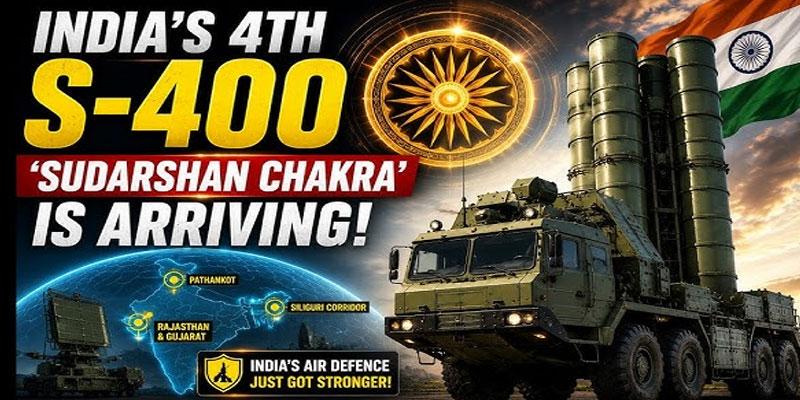
India has received its fourth Russian-origin S-400 Triumf squadron, significantly strengthening its ability to counter aircraft, cruise missiles, ballistic missiles and drones along sensitive borders. Capable of engaging threats up to 400 kilometres away, the advanced system marks a major boost to India’s multi-layered air defence network amid evolving regional security challenges.
Why the S-400 Matters
India signed a deal with Russia for five S-400 squadrons to address critical gaps in its long-range air defence capabilities. The system was acquired amid growing concerns over the expanding missile and air power capabilities of neighbouring adversaries.
Unlike conventional air defence systems designed for a single threat profile, the S-400 is built around a layered interception architecture capable of detecting, tracking and neutralizing multiple targets simultaneously. Its operational flexibility enables it to engage strategic bombers, airborne early warning aircraft, fighter jets, cruise missiles, ballistic missiles and drones across varying distances and altitudes.
The system's importance has grown as modern conflicts increasingly involve coordinated attacks using a combination of missiles, drones and electronic warfare assets, requiring integrated and highly responsive defence networks.
Multi-Layered Protection Against Diverse Threats
The long-range 40N6 missile can intercept targets up to 400 kilometres away, while the 48N6 missile covers threats at 250 kilometres. The 9M96E2 missile provides medium-range protection up to 120 kilometres, and the 9M96E is designed for short-range engagements within 40 kilometres.
This layered structure creates overlapping zones of protection, significantly reducing the chances of hostile aircraft or missiles penetrating defended airspace. The system can also track and engage multiple targets simultaneously, making it highly effective against saturation attacks.
Operational Success and Expansion Plans
Confidence in the S-400 has grown after its reported success during Operation Sindoor in countering aerial threats. Following this, the Defence Acquisition Council approved 288 additional missiles worth nearly ₹10,000 crore and cleared five more S-400 squadrons, strengthening protection for critical military and civilian infrastructure.
Integration with Indigenous Defence Systems
India’s air defence strategy relies on a layered, integrated network combining the S-400 with the Barak-8/MRSAM, Akash, and Akash-NG systems. Together, they provide seamless long-, medium- and short-range protection, supported by advanced command-and-control networks for rapid threat detection and response.
Strategic Significance and the Road to Self-Reliance
While the S-400 addresses immediate operational requirements, India is simultaneously pursuing long-term strategic autonomy through Project Kusha, an indigenous long-range air defence programme being developed by DRDO and Bharat Electronics Limited. Designed to offer capabilities comparable to the S-400, the project aims to reduce dependence on foreign suppliers while strengthening domestic defence manufacturing.
Balancing Capability with Strategic Autonomy
The induction of the fourth S-400 squadron represents a major enhancement of India's air defence capabilities and reinforces its preparedness against complex aerial threats. More importantly, it reflects a broader strategy that combines advanced foreign acquisitions with indigenous innovation. As India continues to modernize its defence infrastructure, the S-400 serves as both a critical operational asset and a bridge toward greater self-reliance, helping create a resilient and comprehensive air defence shield for the future.
(With agency inputs)