
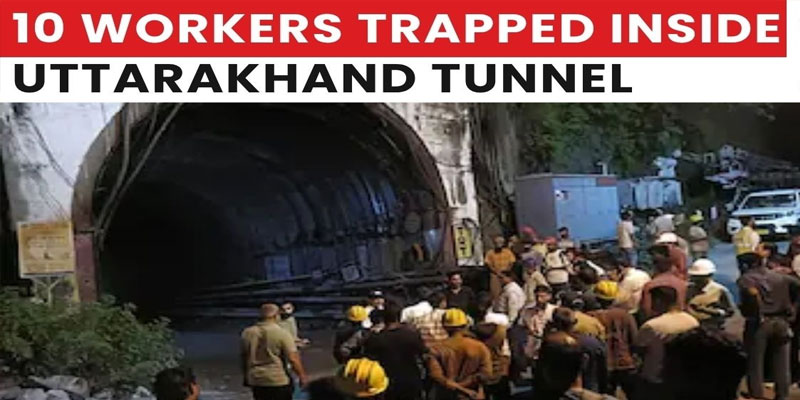
A devastating tunnel collapse at an under-construction hydroelectric project in Uttarakhand's Chamoli district has shifted from a frantic rescue effort to a targeted search-and-recovery mission as the death toll climbed to seven. The tragedy unfolded after a sudden surge of water and debris flooded the Tehri Hydro Development Corporation (THDC) tunnel near Pipalkoti, trapping workers inside and triggering a massive multi-agency rescue operation involving the NDRF, SDRF, police, and other emergency forces.
How the Disaster Unfolded
The incident occurred around 6.30–6.45 pm on August 13, when a large volume of water and debris suddenly entered the under-construction tunnel where workers were carrying out excavation and construction work.
Initial estimates suggested that around 20–22 labourers were inside the tunnel. Rescue teams managed to evacuate most workers within hours, but several were found critically injured. As authorities reconciled attendance records overnight, seven workers were confirmed dead after being taken to the District Hospital in Gopeshwar, while more than a dozen sustained injuries. A few workers remained unaccounted for as rescue teams continued searching through the affected tunnel section.
Race Against Time Underground
Uttarakhand Chief Minister Pushkar Singh Dhami ordered an immediate and coordinated rescue operation, directing all agencies to work on a "war footing."
National Disaster Response Force (NDRF), State Disaster Response Force (SDRF), CISF, ITBP, police personnel, and other emergency teams were deployed to the site. High-capacity pumps were brought in to drain accumulated water, while heavy machinery was used to remove thick layers of slush and debris blocking access to the collapsed section.
However, unstable tunnel conditions, continuous water seepage, and confined underground spaces have made rescue operations extremely challenging. Teams have been forced to proceed cautiously to prevent further cave-ins while attempting to reach the remaining trapped workers.
Medical Response and Administrative Coordination
Rescued workers were rushed to the District Hospital in Gopeshwar for emergency treatment. While seven victims were declared dead, several injured workers continue receiving medical care, with at least one critically injured labourer shifted to Base Hospital in Srinagar for advanced treatment.
District authorities have reiterated that rescue efforts will continue until every missing worker is located, even as operations increasingly focus on safely accessing the sealed-off portion of the tunnel.
A Familiar Warning for Himalayan Infrastructure
The Chamoli disaster has revived painful memories of the 2021 Rishiganga-Dhauli Ganga catastrophe, which exposed the vulnerability of large infrastructure projects in the fragile Himalayan region.
Although investigators are yet to determine whether the latest incident was caused by heavy rainfall, geological failure, or a breach within the tunnel, experts note that water ingress and sudden debris flows remain among the greatest hazards in underground hydropower construction. The tragedy is expected to intensify scrutiny of safety audits, real-time monitoring systems, emergency evacuation mechanisms, and construction protocols across similar projects in Uttarakhand.
A Wake-Up Call Beyond the Rescue
The Chamoli tunnel tragedy is not merely another industrial accident—it is a stark reminder of the enormous risks faced by workers building critical infrastructure in geologically unstable terrain. As rescue teams continue battling hazardous underground conditions, the larger challenge lies in ensuring that future hydropower projects prioritize worker safety, scientific risk assessment, and robust emergency preparedness with the same urgency as engineering ambition.
(With agency inputs)