
A Bold New Chapter in India’s Solar Manufacturing Story
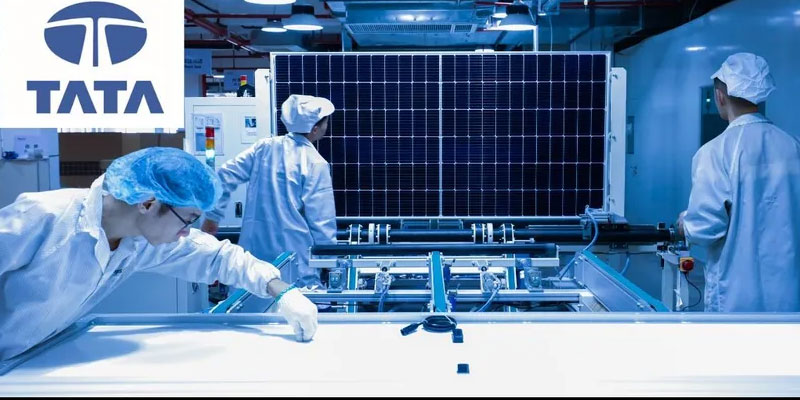
Tata Power is in early-stage discussions with the Odisha government to set up a massive 10 GW ingots and wafers manufacturing plant, a project valued at approximately ₹10,000 crore. Proposed locations such as Gopalpur Industrial Park and Cuttack offer port connectivity, enabling efficient domestic supply and export potential.
Ingots and wafers—core inputs for solar cells, modules, and even semiconductors—represent the most critical missing link in India’s solar manufacturing chain. With Tata Power already operating 4.55 GW of cell and module capacity across Tirunelveli and Bengaluru, this upstream leap marks a strategic shift toward full vertical integration.
Strategic Backward Integration: Reducing Dependence, Securing Scale
India currently depends heavily on imports—mostly from China—for polysilicon-based ingots and wafers. With rising global tariffs, geopolitical risks, and supply chain fragility, domestic manufacturing has become a national priority.
Tata Power’s move plugs a crucial gap in its own value chain while supporting its accelerated renewable ambitions. The company aims for 33 GW of utility-scale renewable assets by FY30, up from 5.7 GW today. CEO Praveer Sinha stressed that while India now has sufficient cell and module capacity, the upstream supply deficit remains the biggest constraint.
A domestic 10 GW wafer plant would not only meet internal needs but also position Tata Power as a supplier to India’s booming solar ecosystem, which is projected to reach 500 GW capacity by 2030.
Economic Boost for Odisha and National Competitiveness
The ₹10,000 crore facility promises major economic dividends:
· Thousands of skilled jobs in advanced manufacturing
· Strengthening of Odisha’s industrial zone alongside Tata Steel’s Gopalpur SEZ
· Attraction of ancillary industries, creating a solar manufacturing cluster
· Increased investor confidence due to port proximity and state incentives
Nationally, the project supports India’s Production-Linked Incentive (PLI) schemes and reduces an annual ₹20,000+ crore import bill. It also intensifies competition with domestic heavyweights such as Adani and Waaree, pushing India closer to solar self-sufficiency under Atmanirbhar Bharat.
Global Export Opportunities: A New Market for Indian Wafers
Tata Power’s proposed facility taps into a global market that is rapidly diversifying away from Chinese dependence. Key export destinations include:
Southeast Asia
· Vietnam (28% of global wafer imports)
· Indonesia, Thailand, and Laos (major cell/module assembly hubs)
These markets re-export finished modules to India, Turkey, and the U.S., making them high-volume wafer importers.
Middle East and South Asia
Proximity gives India a logistics advantage for supplying emerging solar programs in UAE, Saudi Arabia, Bangladesh, and Sri Lanka.
Africa
Growing assembly hubs for exporting modules to the U.S. under tariff exemptions.
Europe and the United States
With Western countries erecting tariff barriers against China, India could serve as a non-China alternative for high-efficiency wafers.
Competitiveness Drivers
· PLI incentives and lower energy/labor costs
· Renewable power availability reducing production costs
· Vertical integration boosting margins (20–30% for wafers vs. ~10% for modules)
· Potential technology partnerships for high-yield mono-crystalline wafers
India’s solar module exports have already grown 5x since FY23, providing a ready downstream base for wafer sales.
A Defining Move for India’s Solar Future
Tata Power’s 10 GW ingots and wafers project marks one of India’s most ambitious steps toward solar sovereignty. By bridging the upstream manufacturing gap, boosting export potential, and strengthening Odisha’s industrial landscape, the initiative positions India to compete in a global market long dominated by China.
If executed with technological depth and supply-chain resilience, the facility could transform India from a module assembler into a full-spectrum solar manufacturing powerhouse, accelerating the nation’s energy transition and economic modernization.
(With agency inputs)