

Rupee Slides to Historic Lows
The Indian rupee has plunged to a record low against the US dollar, as escalating tensions between the United States and Iran unsettle global markets. Since the onset of the conflict, the rupee has depreciated by around 4.5 percent, mirroring a broader weakening across Asian currencies. However, analysts caution that India’s exposure to rising oil prices and capital outflows makes it particularly vulnerable if the geopolitical crisis persists.
What’s Driving the Fall? A Perfect Storm of Pressures
Recent trading sessions have seen the rupee breach the 95-per-dollar mark, a sharp fall from pre-conflict levels in the low 90s. The decline is being driven by a combination of global and domestic factors, creating a “perfect storm” for the currency.
At the center lies crude oil. As tensions in the Middle East escalate, oil prices have surged to multi-year highs. For an energy-import-dependent economy like India, this translates directly into a widening trade deficit and rising import bills. Higher fuel costs also feed into inflation, affecting everything from transportation to food prices.
Simultaneously, a strong dollar—supported by a hawkish stance from the US Federal Reserve—has intensified pressure on emerging market currencies. Investors seeking safer returns have shifted capital toward US assets, leading to significant outflows from Indian equities and bonds.
RBI’s Role: Managing Volatility, Not Fixing Levels
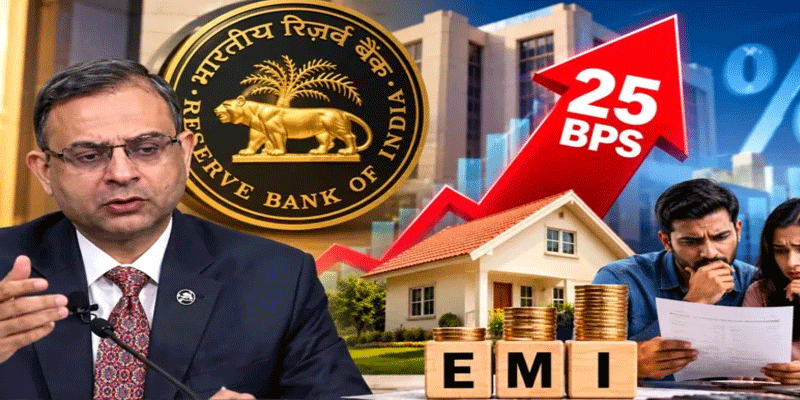
Amid the sharp depreciation, the Reserve Bank of India is believed to have intervened in the foreign exchange market through state-run banks. The central bank’s strategy appears to be one of moderation rather than control—aiming to smooth excessive volatility without defending a specific exchange rate.
India’s relatively strong foreign exchange reserves provide a buffer, allowing the RBI to “lean against the wind” and prevent disorderly movements. However, policymakers recognize that in a global shock driven by war and energy prices, some level of currency weakening is inevitable.
Deeper Risks: Inflation, Growth and Capital Flows
The rupee’s slide is not just a currency story—it has wider macroeconomic implications. A weaker rupee increases the cost of imports, particularly oil, which can push inflation higher and reduce consumer purchasing power. This, in turn, may slow economic growth.
Foreign portfolio investors have already withdrawn billions from Indian markets during the conflict period, exacerbating pressure on the currency. While India entered this phase with relatively stable fundamentals, prolonged geopolitical instability could erode these advantages.
Experts suggest that boosting capital inflows will be critical. Measures such as expanding foreign investment in Indian bonds, maintaining stable regulatory frameworks, and accelerating reforms to attract long-term investment could help stabilize the situation.
Navigating Uncertainty in a Volatile World
The rupee’s record decline underscores how deeply interconnected global geopolitics and domestic economics have become. While India’s fundamentals remain resilient, external shocks—especially those linked to energy and capital flows—can quickly alter the landscape.
The challenge for policymakers is to strike a balance between intervention and market-driven adjustment, while reinforcing investor confidence. Ultimately, the trajectory of the rupee will depend not just on domestic policy, but on how the broader geopolitical crisis unfolds.
In a world shaped by uncertainty, stability will hinge on both strategic foresight and global cooperation.
(With agency inputs)