
Pope Leo XIV Raises Alarm Over Artificial Intelligence
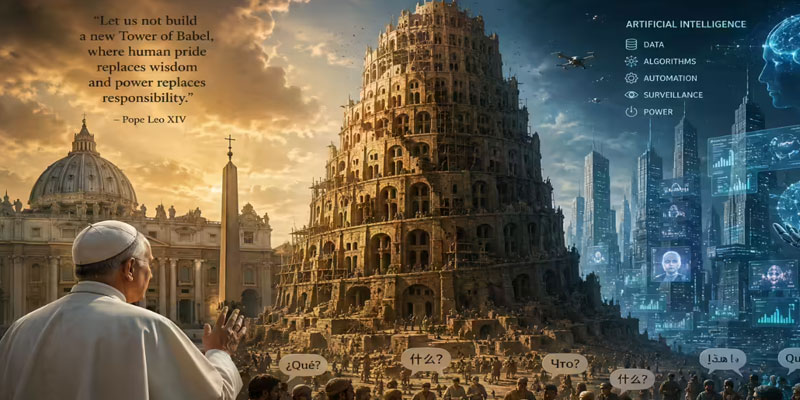
Artificial intelligence has become one of the most transformative technologies of the modern era, but Pope Leo XIV believes it could also become one of humanity’s greatest risks if left unchecked. In a striking intervention, the pontiff has compared the rapid development of AI to the Biblical Tower of Babel, warning that humanity may be repeating an ancient mistake—allowing technological ambition to outpace ethical responsibility.
The warning comes through Magnifica Humanitas (“Magnificent Humanity”), Pope Leo XIV’s first encyclical, in which he describes AI as a defining civilizational challenge of the 21st century. Rather than viewing artificial intelligence merely as a technological innovation, the Pope presents it as a force capable of reshaping economies, politics, warfare, culture and even humanity’s understanding of itself.
Understanding the Tower of Babel Analogy
At the heart of the Pope’s message lies the Biblical story of the Tower of Babel, found in the Book of Genesis. According to the narrative, humanity sought to build a towering structure reaching the heavens, symbolizing collective power and ambition. The project ultimately resulted in confusion, division and the fragmentation of language and culture.
Pope Leo argues that modern societies may be constructing a similar “tower,” not from bricks and stone but from algorithms, data networks and automated systems. The promise of AI is unprecedented efficiency, connectivity and control. Yet, he warns, these same ambitions can foster a dangerous sense of technological omnipotence, where economic gain and geopolitical competition overshadow ethical considerations.
In this sense, the Pope sees AI not simply as a tool but as a test of humanity’s moral maturity.
AI, Power and the Risk of New Divisions
One of the encyclical’s central concerns is that unchecked AI could deepen existing social and political divides.
The Pope warns that powerful AI systems may concentrate influence in the hands of a small number of governments and technology corporations, creating what he describes as new forms of digital inequality. Control over vast amounts of data, advanced computing infrastructure and algorithmic decision-making could give rise to a new class of “digital elites” with disproportionate power over societies.
He also points to the dangers of misinformation, surveillance and opaque algorithms that affect everyday decisions without public scrutiny. According to the Pope, such developments risk undermining transparency, accountability and democratic participation.
A Call to “Disarm” Artificial Intelligence
A particularly strong section of the encyclical focuses on the military use of AI.
Pope Leo XIV argues that autonomous weapons capable of selecting and attacking targets without meaningful human oversight represent a profound ethical danger. He calls for AI to be “disarmed” from systems that enable domination, exclusion and violence.
The pontiff has urged governments, international institutions and technology companies to establish robust legal safeguards, independent oversight mechanisms and global ethical standards before AI capabilities advance further.
Protecting Human Dignity in the Age of Automation
Beyond security concerns, the Pope highlights the impact of AI on work and human dignity. He cautions that excessive automation could reduce people to mere components within highly efficient economic systems.
While acknowledging the benefits of innovation, he insists that creativity, empathy, solidarity and care remain uniquely human qualities that cannot be replicated by machines. He therefore advocates stronger worker protections, investment in re-skilling and policies that ensure technological progress benefits society as a whole.
An Ethical Crossroads for Humanity
Pope Leo XIV’s warning is ultimately less about technology itself and more about the values guiding its development. By invoking the Tower of Babel, he argues that the greatest danger lies not in artificial intelligence, but in human arrogance and the belief that technological power alone can solve society’s challenges. As AI becomes increasingly embedded in everyday life, the Pope’s message serves as a reminder that innovation without ethics can lead to fragmentation rather than progress. The challenge for governments, businesses and citizens alike is to ensure that humanity remains firmly in control of the technologies it creates.
(With agency inputs)