Supreme Court Intervenes in High-Profile Medical Dispute
Pakistan’s Supreme Court has ordered the immediate transfer of former Prime Minister Imran Khan from Adiala Jail to Shifa International Hospital in Islamabad, marking a significant judicial intervention in the long-running controversy surrounding his health and incarceration. The 73-year-old founder of the Pakistan Tehreek-e-Insaf (PTI), imprisoned since August 2023 while facing multiple legal cases, will now receive treatment at a private hospital after his family and lawyers repeatedly sought access to doctors of his choice.
The ruling transforms what had largely been a politically contested issue into one under direct judicial supervision, placing Khan’s medical care squarely within the ambit of Pakistan’s highest court.
From Prison Complaint to Judicial Oversight
The dispute over Khan’s health had intensified for months as PTI accused prison authorities of denying him adequate treatment, limiting access to family members and lawyers, and neglecting his deteriorating condition. The party particularly questioned official claims that Khan’s eyesight had improved following treatment at the state-run Pakistan Institute of Medical Sciences.
The Supreme Court’s intervention comes after conflicting medical reports raised concerns about the credibility of the prison administration’s assessments, making judicial oversight appear increasingly necessary.
Conflicting Medical Reports Deepen Questions
The immediate trigger for the court’s order was a series of contradictory medical evaluations.
Adiala Jail authorities maintained that Khan’s central retinal vein occlusion in his right eye had improved considerably. However, other medical records reportedly documented persistent health concerns, including palpitations, headaches, anxiety, restlessness and elevated blood pressure.
Doctors also recommended that Khan receive more regular contact with his wife and family, arguing that such interactions could help reduce anxiety and stabilise his blood pressure. By shifting him to Shifa International Hospital, the court has created the possibility of an independently verifiable medical record, potentially reducing disputes over whether his condition has been exaggerated or neglected.
Political Fallout Beyond Medical Care
Khan’s imprisonment remains one of the defining fault lines in Pakistan’s deeply polarised politics. PTI supporters continue to portray him as the victim of politically motivated prosecutions, while the government insists that the legal proceedings are independent of his political stature.
The controversy has been amplified by restrictions on meetings with family members and party leaders, which PTI argues affect both Khan’s personal welfare and his ability to communicate politically.
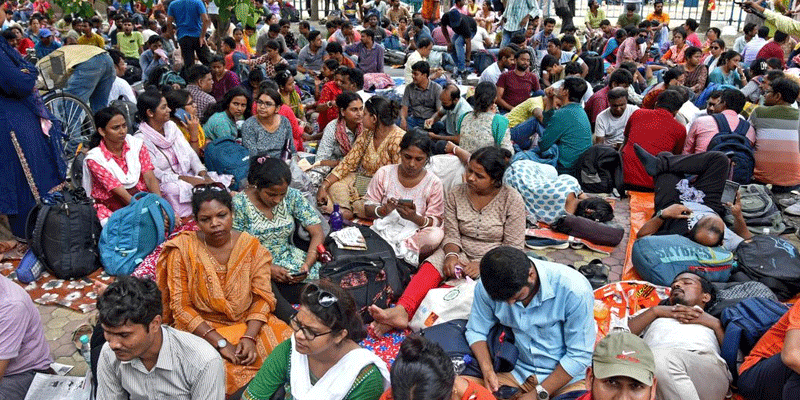
The issue has also intensified tensions between Pakistan’s federal government and Khyber Pakhtunkhwa, the province governed by PTI. Chief Minister Sohail Afridi recently joined a sit-in outside the Supreme Court, warning that growing public anger—particularly among young supporters—could trigger wider protests if restrictions on Khan persisted.
A Critical Test for Pakistan’s Institutions
The hospital transfer may ease immediate tensions, but it is unlikely to end the broader political confrontation. Much will depend on whether Khan is granted meaningful access to family, personal physicians and legal representatives during his treatment. If restrictions continue, PTI is likely to renew its allegations of institutional bias.
More importantly, the episode underscores the importance of transparent medical procedures, consistent visitation rules and timely judicial compliance. The Supreme Court has provided an immediate safeguard for Khan’s health, but restoring public confidence in Pakistan’s justice system will require credible legal processes that rise above political contestation.
(With agency inputs)